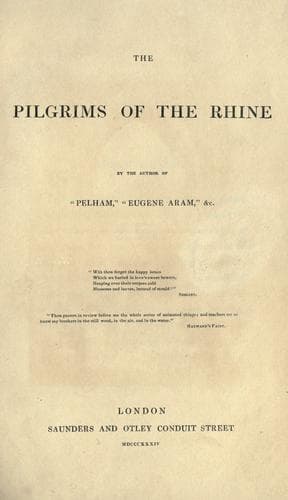
The Pilgrims of the RhineLytton, Edward Bulwer Lytton, Baron
Science
The Pilgrims of the Rhine
Lytton, Edward Bulwer Lytton, Baron
Fairies -- Fiction; Fantasy fiction; Rhine River Valley -- Fiction
From that hour all Lucille’s happiness was at an end; her fairy palace
was shattered in the dust; the magician’s wand was broken up; the
Ariel was given to the winds; and the bright enchantment no longer
distinguished the land she lived in from the rest of the barren
world. It is true that St. Amand’s words were kind; it is true that he
remembered with the deepest gratitude all she had done in his behalf;
it is true that he forced himself again and again to say, “She is my
betrothed, my benefactress!” and he cursed himself to think that the
feelings he had entertained for her were fled. Where was the passion of
his words; where the ardour of his tone; where that play and light of
countenance which her step, her voice, could formerly call forth? When
they were alone he was embarrassed and constrained, and almost cold;
his hand no longer sought hers, his soul no longer missed her if she was
absent a moment from his side. When in their household circle he seemed
visibly more at ease; but did his eyes fasten upon her who had opened
them to the day; did they not wander at every interval with a too
eloquent admiration to the blushing and radiant face of the exulting
Julie? This was not, you will believe, suddenly perceptible in one
day or one week, but every day it was perceptible more and more. Yet
still--bewitched, ensnared, as St. Amand was he never perhaps would have
been guilty of an infidelity that he strove with the keenest remorse to
wrestle against, had it not been for the fatal contrast, at the first
moment of his gushing enthusiasm, which Julie had presented to Lucille;
but for that he would have formed no previous idea of real and living
beauty to aid the disappointment of his imaginings and his dreams.
He would have seen Lucille young and graceful, and with eyes beaming
affection, contrasted only by the wrinkled countenance and bended frame
of her parents, and she would have completed her conquest over him
before he had discovered that she was less beautiful than others; nay,
more,--that infidelity never could have lasted above the first few days,
if the vain and heartless object of it had not exerted every art, all
the power and witchery of her beauty, to cement and continue it. The
unfortunate Lucille--so susceptible to the slightest change in those
she loved, so diffident of herself, so proud too in that diffidence--no
longer necessary, no longer missed, no longer loved, could not bear to
endure the galling comparison between the past and the present. She
fled uncomplainingly to her chamber to indulge her tears, and thus,
unhappily, absent as her father generally was during the day, and busied
as her mother was either at work or in household matters, she left Julie
a thousand opportunities to complete the power she had begun to wield
over--no, not the heart!--the _senses_ of St. Amand! Yet, still not
suspecting, in the open generosity of her mind, the whole extent of her
Public-domain text, read in full here on John Shaqi.
Reviews
Reviews
No reviews yet
Be the first to share your thoughts on this work.
Join the Discussion
Join the discussion
Sign in to leave a comment or review.
Sign InorCreate an account