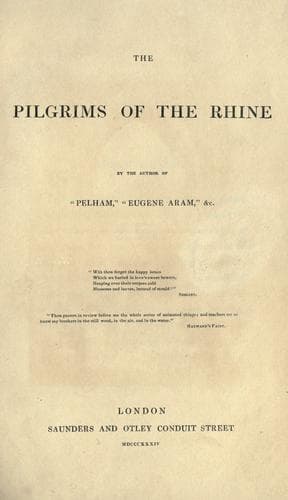
The Pilgrims of the RhineLytton, Edward Bulwer Lytton, Baron
Science
The Pilgrims of the Rhine
Lytton, Edward Bulwer Lytton, Baron
Fairies -- Fiction; Fantasy fiction; Rhine River Valley -- Fiction
affliction, poor Lucille buoyed herself at times with the hope that when
once married, when, once in that intimacy of friendship, the unspeakable
love she felt for him could disclose itself with less restraint than at
present,--she would perhaps regain a heart which had been so devotedly
hers, that she could not think that without a fault it was irrevocably
gone: on that hope she anchored all the little happiness that remained
to her. And still St. Amand pressed their marriage, but in what
different tones! In fact, he wished to preclude from himself the
possibility of a deeper ingratitude than that which he had incurred
already. He vainly thought that the broken reed of love might be bound
up and strengthened by the ties of duty; and at least he was anxious
that his hand, his fortune, his esteem, his gratitude, should give
to Lucille the only recompense it was now in his power to bestow.
Meanwhile, left alone so often with Julie, and Julie bent on achieving
the last triumph over his heart, St. Amand was gradually preparing a
far different reward, a far different return, for her to whom he owed so
incalculable a debt.
There was a garden, behind the house, in which there was a small
arbour, where often in the summer evenings Eugene and Lucille had
sat together,--hours never to return! One day she heard from her own
chamber, where she sat mourning, the sound of St. Amand’s flute swelling
gently from that beloved and consecrated bower. She wept as she heard
it, and the memories that the music bore softening and endearing his
image, she began to reproach herself that she had yielded so often to
the impulse of her wounded feelings; that chilled by _his_ coldness, she
had left him so often to himself, and had not sufficiently dared to
tell him of that affection which, in her modest self-depreciation,
constituted her only pretension to his love. “Perhaps he is alone now,”
she thought; “the air too is one which he knows that I love;” and with
her heart in her step, she stole from the house and sought the arbour.
She had scarce turned from her chamber when the flute ceased; as she
neared the arbour she heard voices,--Julie’s voice in grief, St. Amand’s
in consolation. A dread foreboding seized her; her feet clung rooted to
the earth.
“Yes, marry her, forget me,” said Julie; “in a few days you will
be another’s, and I--I--forgive me, Eugene, forgive me that I have
disturbed your happiness. I am punished sufficiently; my heart will
break, but it will break in loving you.” Sobs choked Julie’s voice.
Public-domain text, read in full here on John Shaqi.
Reviews
Reviews
No reviews yet
Be the first to share your thoughts on this work.
Join the Discussion
Join the discussion
Sign in to leave a comment or review.
Sign InorCreate an account