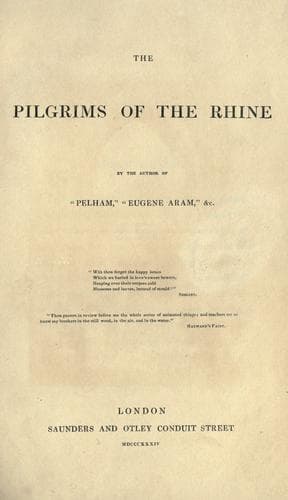
The Pilgrims of the RhineLytton, Edward Bulwer Lytton, Baron
Science
The Pilgrims of the Rhine
Lytton, Edward Bulwer Lytton, Baron
Fairies -- Fiction; Fantasy fiction; Rhine River Valley -- Fiction
“That which I foresaw has come to pass; I am no longer to you what I
once was, when you could clothe this poor form and this homely face with
a beauty they did not possess. You would wed me still, it is true; but I
am proud, Eugene, and cannot stoop to gratitude where I once had love.
I am not so unjust as to blame you; the change was natural, was
inevitable. I should have steeled myself more against it; but I am now
resigned. We must part; you love Julie--that too is natural--and _she_
loves you; ah! what also more in the probable course of events? Julie
loves you, not yet, perhaps, so much as I did; but then she has not
known you as I have, and she whose whole life has been triumph cannot
feel the gratitude that I felt at fancying myself loved; but this will
come--God grant it! Farewell, then, forever, dear Eugene; I leave you
when you no longer want me; you are now independent of Lucille; wherever
you go, a thousand hereafter can supply my place. Farewell!”
She rose, as she said this, to leave the room; but St. Amand seizing her
hand, which she in vain endeavoured to withdraw from his clasp, poured
forth incoherently, passionately, his reproaches on himself, his
eloquent persuasion against her resolution.
“I confess,” said he, “that I have been allured for a moment; I confess
that Julie’s beauty made me less sensible to your stronger, your holier,
oh! far, far holier title to my love! But forgive me, dearest Lucille;
already I return to you, to all I once felt for you; make me not curse
the blessing of sight that I owe to you. You must not leave me; never
can we two part. Try me, only try me, and if ever hereafter my heart
wander from you, _then_, Lucille, leave me to my remorse!”
Even at that moment Lucille did not yield; she felt that his prayer was
but the enthusiasm of the hour; she felt that there was a virtue in her
pride,--that to leave him was a duty to herself. In vain he pleaded; in
vain were his embraces, his prayers; in vain he reminded her of their
plighted troth, of her aged parents, whose happiness had become wrapped
in her union with him: “How,--even were it as you wrongly believe,--how,
in honour to them, can I desert you, can I wed another?”
“Trust that, trust all, to me,” answered Lucille; “your honour shall
be my care, none shall blame _you_; only do not let your marriage with
Julie be celebrated here before their eyes: that is all I ask, all they
can expect. God bless you! do not fancy I shall be unhappy, for whatever
happiness the world gives you, shall I not have contributed to bestow
it? and with that thought I am above compassion.”
Public-domain text, read in full here on John Shaqi.
Reviews
Reviews
No reviews yet
Be the first to share your thoughts on this work.
Join the Discussion
Join the discussion
Sign in to leave a comment or review.
Sign InorCreate an account