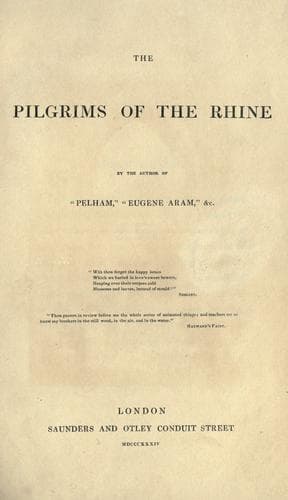
The Pilgrims of the RhineLytton, Edward Bulwer Lytton, Baron
Science
The Pilgrims of the Rhine
Lytton, Edward Bulwer Lytton, Baron
Fairies -- Fiction; Fantasy fiction; Rhine River Valley -- Fiction
She glided from his arms, and left him to a solitude more bitter even
than that of blindness. That very night Lucille sought her mother; to
her she confided all. I pass over the reasons she urged, the arguments
she overcame; she conquered rather than convinced, and leaving to Madame
le Tisseur the painful task of breaking to her father her unalterable
resolution, she quitted Malines the next morning, and with a heart too
honest to be utterly without comfort, paid that visit to her aunt which
had been so long deferred.
The pride of Lucille’s parents prevented them from reproaching St.
Amand. He could not bear, however, their cold and altered looks; he left
their house; and though for several days he would not even see Julie,
yet her beauty and her art gradually resumed their empire over him. They
were married at Courtroi, and to the joy of the vain Julie departed to
the gay metropolis of France. But, before their departure, before his
marriage, St. Amand endeavoured to appease his conscience by obtaining
for M. le Tisseur a much more lucrative and honourable office than that
he now held. Rightly judging that Malines could no longer be a pleasant
residence for them, and much less for Lucille, the duties of the post
were to be fulfilled in another town; and knowing that M. le Tisseur’s
delicacy would revolt at receiving such a favour from his hands, he kept
the nature of his negotiation a close secret, and suffered the honest
citizen to believe that his own merits alone had entitled him to so
unexpected a promotion.
Time went on. This quiet and simple history of humble affections took
its date in a stormy epoch of the world,--the dawning Revolution of
France. The family of Lucille had been little more than a year settled
in their new residence when Dumouriez led his army into the Netherlands.
But how meanwhile had that year passed for Lucille? I have said that her
spirit was naturally high; that though so tender, she was not weak. Her
very pilgrimage to Cologne alone, and at the timid age of seventeen,
proved that there was a strength in her nature no less than a devotion
in her love. The sacrifice she had made brought its own reward.
She believed St. Amand was happy, and she would not give way to the
selfishness of grief; she had still duties to perform; she could still
comfort her parents and cheer their age; she could still be all the
world to them: she felt this, and was consoled. Only once during the
year had she heard of Julie; she had been seen by a mutual friend at
Paris, gay, brilliant, courted, and admired; of St. Amand she heard
nothing.
Public-domain text, read in full here on John Shaqi.
Reviews
Reviews
No reviews yet
Be the first to share your thoughts on this work.
Join the Discussion
Join the discussion
Sign in to leave a comment or review.
Sign InorCreate an account