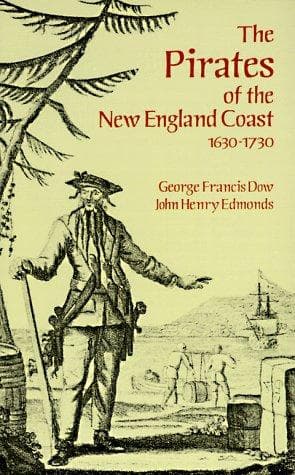
The pirates of the New England coast, 1630-1730Dow, George Francis
History
The pirates of the New England coast, 1630-1730
Dow, George Francis
New England -- History -- Colonial period, ca. 1600-1775; Pirates -- New England -- History
The agents sent over by the Lords of Trade and Plantations were unable
to make progress against the flagrant evasions of the Navigation Acts.
Randolph, who arrived in Boston in 1679, was the most active of these
agents, and when he seized several vessels for irregular trading,
the courts decided against him and “damages were given against his
Majesty.”[18] He afterwards complained of those privateers that were
fitting out for the Spanish West Indies and writes of Mr. Wharton of
Boston, as “a great undertaker for pyratts and promoter of irregular
trade.” “New England rogues and pitiful damned Scotch pedlars,” he
termed those who opposed him. The pirates or privateers were supplied
with provisions by vessels from the mainland and prize goods were taken
in payment. Vessels were often fitted out at Rhode Island and manned in
New York and Arabian gold was to be found in both colonies; “in fact,
’tis the most beneficiall trade, that to Madagascar with the pirates,
that was ever heard of, and I believe there’s more got that way than
by turning pirates and robbing.” So wrote the New York governor, and
later, he again wrote to the Lords at Whitehall: “The temptation is soe
great to the common seamen in that part of the world where the Moores
have so many rich ships and the seamen have a humour more now than ever
to turne pirates.”[19]
The profits of piracy and the irregular trade practiced at that time
were large, indeed, and twenty-nine hundred per cent profit in illicit
trade was not unusual, so there is little wonder that adventurous
men took chances and honest letters-of-marque sometimes seized upon
whatever crossed their course. The pirate, the privateer and the armed
merchantman often blended the one into the other.
FOOTNOTES
[1] _True Travels, Adventures and Observations of Captain John Smith_,
London, 1630.
[2] Oppenheim, _The Administration of the Royal Navy_, p. 177.
[3] _True Travels, Adventures and Observations of Captain John Smith_,
London, 1630.
[4] _Purchas, His Pilgrimage_, Vol. IV, p. 1882.
[5] Perforst, _i.e._, forced.
[6] Mainwaring, _The Beginnings, Practices and Suppression of Pirates,
ca. 1717_. MS. in British Museum.
[7] To ply: to beat up against a wind.
[8] Floaty, _i.e._, draw little water.
[9] As early as 1613, English pirates were established at Mamora, at
the mouth of the Sebu River on the Barbary Coast. That year about
thirty sail were using the port.
[10] By 1618 there were one hundred and fifty Turkish vessels to only
twenty English at Algiers.
[11] Doyle, _English Colonies in America_, Vol. I, p. 383.
[12] _Massachusetts Archives_, Vol. 35, folio 61.
[13] John Esquemeling, _The Buccaneers of America_, London, 1684.
[14] Viscount Bury, _Exodus of the Western Nations_, Vol. II, London,
1865.
[15] _New York Colonial Documents_, Vol. IV, p. 447.
[16] _New York Colonial Documents_, Vol. IV, p. 1116.
[17] Babson, _History of Gloucester_, p. 138.
[18] _Andros Tracts_, Vol. III, p. 5.
Public-domain text, read in full here on John Shaqi.
Reviews
Reviews
No reviews yet
Be the first to share your thoughts on this work.
Join the Discussion
Join the discussion
Sign in to leave a comment or review.
Sign InorCreate an account