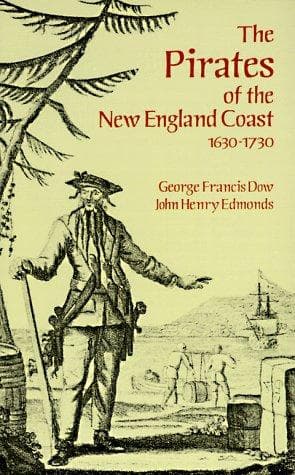
The pirates of the New England coast, 1630-1730Dow, George Francis
History
The pirates of the New England coast, 1630-1730
Dow, George Francis
New England -- History -- Colonial period, ca. 1600-1775; Pirates -- New England -- History
In Rhode Island, the president and four assistants granted these
commissions with the condition that the colony was to share in any
captures. In 1649, Bluefield or Blauvelt, a Dutch privateersman,
brought a prize into Newport, which the governor found was taken during
a truce. But there was no man-of-war in the harbor to enforce the law
and as the townsfolk wanted to buy the cargo and the sailors wanted
the prize money, everybody was satisfied. At a later time Governor
Bellomont of New York complained of the Admiralty Court at Newport as
too “favourable” to piracies and in Queen Anne’s time, Connecticut and
Rhode Island were both complained of because “Her Majesty’s and ye Lord
High Admiral’s dues are sunk in condemning prizes.”[16]
At Stamford, Conn., a prominent citizen had a warehouse “close to the
Sound,” where he received illicit goods and afterwards shipped them to
Boston and other ports. The shore of eastern Long Island was haunted
by smugglers and pirates. Sometimes the wind lay in the other quarter
and a privateersman was adjudged a pirate and hanged. This happened in
Boston in 1704 to John Quelch who had captured Portuguese vessels. But
contemporaries say that officialdom was after a goodly share of the
gold dust that he had brought in. Usually, however, the enterprising
rover lived out his days in the character of a “rich privateer” and
died respected by friends and neighbors.
There were pirates and pirates. Some were letters-of-marque and
legitimate traders and enjoyed the protection of merchants and
officials on shore, while others were outlaws. In 1690, Governor
Bradstreet of the Massachusetts Colony was complaining of the great
damage done to shipping by “French Privateers and Pirates,” and
four years later, Frontenac, the governor of Canada, was asking for
a frigate to cruise about the St. Lawrence against the New England
“_corsaires et filibusters_.” There is no doubt these French privateers
were a considerable menace to New England shipping and that there was
need for privately armed vessels to protect the coast, a task not easy
or desirable; so why should one scrutinize too closely semi-piratical
captures made by so useful friends? In 1709, in mid-winter, a French
privateer appeared off Cape Cod and Governor Dudley ordered Capt.
Abraham Robinson of Gloucester, to man his sloop and sail in pursuit.
It was not an inviting enterprise, especially at that season of the
year, and when the drums went about the town beating up for volunteers,
enlistments languished and the expedition was finally given up. The
minister of the place afterwards wrote to the governor, making excuses
saying “it made them quake to think of turning out of their warm beds
and from good fires, and be thrust into a naked vessel, where they
must lie on the cold, hard ballast, instead of beds, and without fire,
excepting some few who might crowd into the cabin.”[17]
Public-domain text, read in full here on John Shaqi.
Reviews
Reviews
No reviews yet
Be the first to share your thoughts on this work.
Join the Discussion
Join the discussion
Sign in to leave a comment or review.
Sign InorCreate an account