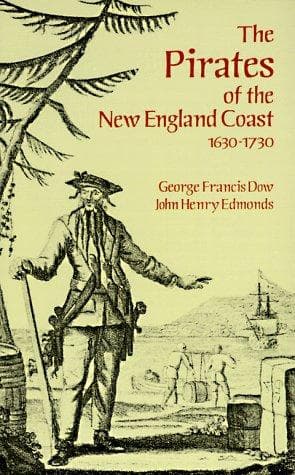
The pirates of the New England coast, 1630-1730Dow, George Francis
History
The pirates of the New England coast, 1630-1730
Dow, George Francis
New England -- History -- Colonial period, ca. 1600-1775; Pirates -- New England -- History
From an original in the library of the Massachusetts
Historical Society.
THE PIRATE SHIPS “ROYAL FORTUNE” AND “RANGER”
IN WHYDAH ROAD, JAN. 11, 1722 360
From an engraving in Johnson’s “General History of
the Pirates,” London, 1725, in possession of George
Francis Dow.
NIX’S MATE, BOSTON HARBOR, IN 1775, WHERE CAPTAIN
FLY WAS GIBBETTED IN 1726 368
From an engraving in the “Atlantic Neptune,” Part III,
London, 1781, in the library of the Massachusetts
Historical Society.
MONUMENT ON THE SHOAL, FORMERLY NIX’S MATE, IN
1637 AN ISLAND OF MORE THAN TEN ACRES 368
From a photograph made about 1900.
MAP OF CAPE COD IN 1717, SHOWING THE LOCATION OF
THE PIRATE WRECK _Back end-paper_
From a chart surveyed and published by Capt. Cyprian
Southack of Boston, now in possession of John W.
Farwell.
INTRODUCTION
Why did men go a-pirating, or “on the account” as the pirates called
it? The sailors said it was few ships and many men, hard work and
small pay, long voyages, bad food and cruel commanders. “Hard ships
make hard men.” “Many sailed but few returned.” “No kind words on deep
water.” “No law off soundings.” “We live hard and die hard and go to
Hell afterwards.” These are some of the sea sayings that have come down
to us from long ago, and they go to prove that the narrow channel of
sailor men was narrow indeed and full of rocks and shoals which could
only be cleared by very careful steering.
The sea was ever a hard calling, especially in the days of which this
work treats. The men before the mast were little better than slaves:
“Growl you may but go you must” was the saying. Small pay (which
they “earned like horses and spent like asses”), scanty food and
often stinking water with generally hard usage turned many an honest
sailorman into a desperate pirate.
Sea captains thought it good policy to keep their men as “busy as the
Devil in a gale of wind” to prevent them doing a job o’ work for that
Gentleman with the long tail, who, it was said, took especial interest
in the doings of “those who go down to the sea in ships.” “Six days
shalt thou labour as hard as thou art able, the seventh, holy-stone
the main deck and chip the chain cable.” Capt. Thomas Phillips wrote
in 1693, that “nothing grates upon the seamen more than pinching their
bellies, or treating them with cruel or reproachful words.”
Public-domain text, read in full here on John Shaqi.
Reviews
Reviews
No reviews yet
Be the first to share your thoughts on this work.
Join the Discussion
Join the discussion
Sign in to leave a comment or review.
Sign InorCreate an account