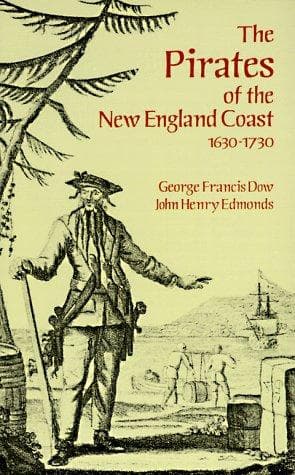
The pirates of the New England coast, 1630-1730Dow, George Francis
History
The pirates of the New England coast, 1630-1730
Dow, George Francis
New England -- History -- Colonial period, ca. 1600-1775; Pirates -- New England -- History
One can easily imagine a group of hard-bitten men sheltering under the
lee of the long boat on a dirty night; wet, cold and tired; listening
with hungry interest to the yarns of an “old stander” who had been “on
the account,” telling of the time he sailed with Bart Sharp or “Long
Ben” Avery; picturing with many a brave oath, that other channel,
the broad one, straight, with smooth water, pieces-of-eight to port,
dollars and doubloons to starboard, snug harbors in tropic isles, dusky
maids, punch, tobacco and grub in plenty, laced coats and chains of
gold.
There is another side to the picture, not so pleasant, to be sure,
but easily dimmed by a noggin of rum or a swig or two of flip. ’Tis
naught, after all, but the yard-arm of a man-of-war with a man on the
end of a tricing line with his flippers seized to his sides; and on a
seashore, a wooden erection with a something hanging--something that
looks uncommonly like a sailorman, watching, with wry face, the ebbing
and flowing of the tide. But there’s nothing in the picture to make one
of the right sort go about ship. Better a short choking sensation than
a long starving in merchants’ employ or scurvy rotting for a pay ticket
on board a king’s ship.
Capt. Charles Johnson tells us in his book on pirates, that one “Mary
Read, a female pirate, being asked by her captain, before he knew
she was a woman, why she followed a life so full of danger and at
last to the certainty of being hanged, replied: as to the hanging she
thought it no great hardship, for were it not for that every cowardly
fellow would turn pirate and so infest the seas that men of courage
would starve. That if it was put to her choice she would not have the
punishment less than death, the fear of which kept dastardly rogues
honest; that many of those who were now cheating the widows and orphans
and oppressing their poor neighbors who had no money to obtain justice,
would then rob at sea and the ocean would be as crowded with rogues
as the land, so that no merchant would venture out and the trade in a
little time would not be worth following.”
Public-domain text, read in full here on John Shaqi.
Reviews
Reviews
No reviews yet
Be the first to share your thoughts on this work.
Join the Discussion
Join the discussion
Sign in to leave a comment or review.
Sign InorCreate an account