Note: Project Gutenberg also has an HTML version of this
file which includes the original illustrations.
See 65720-h.htm or 65720-h.zip:
(http://www.gutenberg.org/files/65720/65720-h/65720-h.htm)
or
(http://www.gutenberg.org/files/65720/65720-h.zip)
Images of the original pages are available through
Internet Archive. See
https://archive.org/details/cu31924028931629
Transcriber’s note:
Text that was in italics is enclosed by underscores (_italics_).
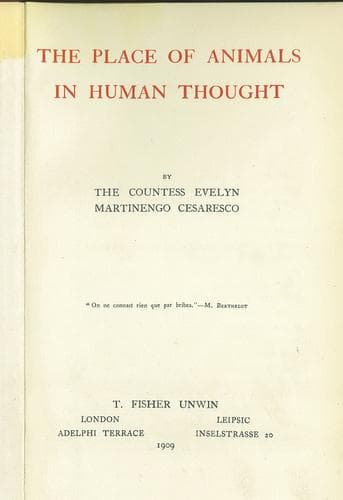
THE PLACE OF ANIMALS IN HUMAN THOUGHT
------------------------------------------------------------------------
[Illustration:
THE EMPEROR AKBAR personally directing the tying up of a wild
Elephant.
Tempera painting by Abu’l Fazl. (1597-98.)
Photographed for this work from the original in the India Museum.]
------------------------------------------------------------------------
THE PLACE OF ANIMALS IN HUMAN THOUGHT
by
THE COUNTESS EVELYN MARTINENGO CESARESCO
“On ne connait rien que par bribes.”—M. BERTHELOT
New York
Charles Scribner’S Sons
153-157 Fifth Avenue
1909
------------------------------------------------------------------------
“C’est l’éternel secret qui veut être gardé.”
(_All rights reserved._)
------------------------------------------------------------------------
PREFACE
AT the Congress held at Oxford in September, 1908, those who heard Count
Goblet d’Alviella’s address on the “Method and Scope of the History of
Religions” must have felt the thrill which announces the stirring of new
ideas, when, in a memorable passage, the speaker asked “whether the
psychology of animals has not equally some relation to the science of
religions?” At any rate, these words came to me as a confirmation of the
belief that the study which has engaged my attention for several years,
is rapidly advancing towards recognition as a branch of the inquiry into
what man is himself. The following chapters on the different answers
given to this question when extended from man to animals, were intended,
from the first, to form a whole, not complete, indeed, but perhaps
fairly comprehensive. I offer them now to the public with my warmest
acknowledgments to the scholars whose published works and, in some
cases, private hints have made my task possible. I also wish to thank
the Editor of the _Contemporary Review_ for his kindness in allowing me
to reprint the part of this book which appeared first in that
periodical.
Some chapters refer rather to practice than to psychology, and others to
myths and fancies rather than to conscious speculation, but all these
subjects are so closely connected that it would be difficult to divide
their treatment by a hard-and-fast line.
Public-domain text, read in full here on John Shaqi.
Reviews
Reviews
No reviews yet
Be the first to share your thoughts on this work.
Join the Discussion
Join the discussion
Sign in to leave a comment or review.
Sign InorCreate an account