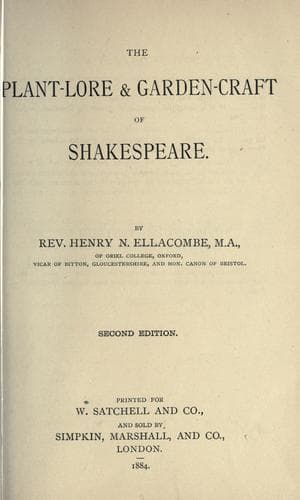
The plant-lore & garden-craft of ShakespeareEllacombe, Henry Nicholson
General
The plant-lore & garden-craft of Shakespeare
Ellacombe, Henry Nicholson
Gardens in literature; Plants in literature; Shakespeare, William, 1564-1616 -- Knowledge -- Botany
In Shakespeare's time a few of the European Conifers were grown in
England, including the Larch, but only as curiosities. The very large
number of species which now ornament our gardens and Pineta from America
and Japan were quite unknown. The many uses of the Pine--for its timber,
production of pitch, tar, resin, and turpentine--were well known and
valued. Shakespeare mentions both pitch and tar.
FOOTNOTES:
[208:1] For many examples see "Catholicon Anglicum," s.v. Pyne-Tree,
with note.
[208:2] The West Indian Pine Apple is described by Gerard as "Ananas,
the Pinea, or Pine Thistle."
PINKS.
(1) _Romeo._
A most courteous exposition.
_Mercutio._
Nay, I am the very Pink of courtesy.
_Romeo._
Pink for flower.
_Mercutio._
Right.
_Romeo._
Why, then is my pump well flowered.
_Romeo and Juliet_, act ii, sc. 4 (60).
(2) _Maiden._
Pinks of odour faint.
_Two Noble Kinsmen_, Introd. song.
To these may perhaps be added the following, from the second verse sung
by Mariana in "Measure for Measure," act iv, sc. 1 (337)--
Hide, oh hide, those hills of snow
Which thy frozen bosom bears!
On whose tops the Pinks that grow
Are of those that April wears.
The authority is doubtful, but it is attributed to Shakespeare in some
editions of his poems.
The Pink or Pincke was, as now, the name of the smaller sorts of
Carnations, and was generally applied to the single sorts. It must have
been a very favourite flower, as we may gather from the phrase "Pink of
courtesy," which means courtesy carried to its highest point; and from
Spenser's pretty comparison--
"Her lovely eyes like Pincks but newly spred."
_Amoretti_, Sonnet 64.
The name has a curious history. It is not, as most of us would suppose,
derived from the colour, but the colour gets its name from the plant.
The name (according to Dr. Prior) comes through _Pinksten_ (German),
from Pentecost, and so was originally applied to one species--the
Whitsuntide Gilliflower. From this it was applied to other species of
the same family. It is certainly "a curious accident," as Dr. Prior
observes, "that a word that originally meant 'fiftieth' should come to
be successively the name of a festival of the Church, of a flower, of an
ornament in muslin called _pinking_, of a colour, and of a sword stab."
Shakespeare uses the word in three of its senses. First, as applied to a
colour--
Come, thou monarch of the Vine,
Plumpy Bacchus with Pink eyne.
_Antony and Cleopatra_, act ii, sc. 7.[210:1]
Second, as applied to an ornament of dress in Romeo's person--
Then is my pump well flowered;
_Romeo and Juliet_, act ii, sc. 4.
_i.e._, well pinked. And in Grumio's excuses to Petruchio for the
non-attendance of the servants--
Public-domain text, read in full here on John Shaqi.
Reviews
Reviews
No reviews yet
Be the first to share your thoughts on this work.
Elsewhere in the archive
Join the Discussion
Join the discussion
Sign in to leave a comment or review.
Sign InorCreate an account