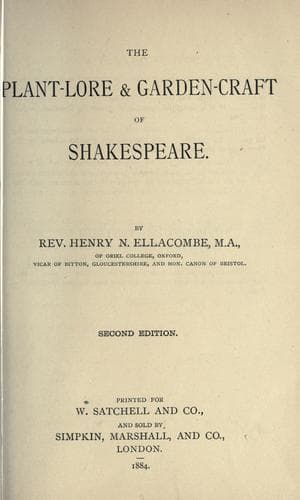
The plant-lore & garden-craft of ShakespeareEllacombe, Henry Nicholson
General
The plant-lore & garden-craft of Shakespeare
Ellacombe, Henry Nicholson
Gardens in literature; Plants in literature; Shakespeare, William, 1564-1616 -- Knowledge -- Botany
Nathaniel's coat, Sir, was not fully made,
And Gabriel's pumps were all unpinked
I' the heel.
_Taming of the Shrew_, act iv, sc. 1.
And thirdly, as the pinked ornament in muslin--
There's a haberdasher's wife of small wit near him, that
railed upon me till her Pink'd porringer fell off her head.
_Henry VIII_, act v, sc. 3.
And as applied to the flower in the passage quoted above. He also uses
it in another sense--
This Pink is one of Cupid's carriers;
Clap on more sail--pursue!
_Merry Wives of Windsor_, act ii, sc. 7.
where pink means a small country vessel often mentioned under that name
by writers of the sixteenth century.
FOOTNOTES:
[210:1] It is very probable that this does not refer to the
colour--"Pink = winking, half-shut."--SCHMIDT. And see Nares, s.v. Pinke
eyne.
PIONY.
_Iris._
Thy banks with Pioned and twilled brims,
Which spongy April at thy best betrims,
To make cold nymphs chaste crowns.
_Tempest_, act iv, sc. 1 (65).
There is much dispute about this passage, the dispute turning on the
question whether "Pioned" has reference to the Peony flower or not. The
word by some is supposed to mean only "digged," and it doubtless often
had this meaning,[211:1] though the word is now obsolete, and only
survives with us in "pioneer," which, in Shakespeare's time, meant
"digger" only, and not as now, "one who goes before to prepare the
way"--thus Hamlet--
Well said, old mole! cans't work i' the earth so fast?
A worthy pioner?
_Hamlet_, act i, sc. 5 (161).
and again--
There might you see the labouring pioner
Begrim'd with sweat, and smeared all with dust.
_Lucrece_ (1380).
But this reading seems very tame, tame in itself, and doubly tame when
taken in connection with the context, and "Certainly savours more of the
commentators' prose than of Shakespeare's poetry" ("Edinburgh Review,"
1872, p. 363). I shall assume, therefore, that the flower is meant,
spelt in the form of "Piony," instead of Peony or Pæony.[211:2]
Public-domain text, read in full here on John Shaqi.
Reviews
Reviews
No reviews yet
Be the first to share your thoughts on this work.
Elsewhere in the archive
Join the Discussion
Join the discussion
Sign in to leave a comment or review.
Sign InorCreate an account