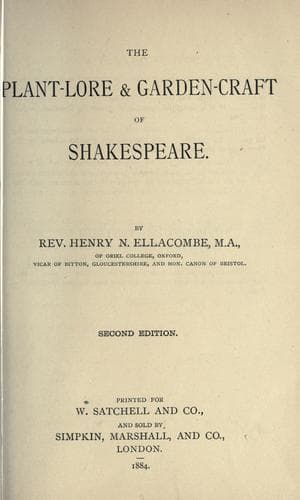
The plant-lore & garden-craft of ShakespeareEllacombe, Henry Nicholson
General
The plant-lore & garden-craft of Shakespeare
Ellacombe, Henry Nicholson
Gardens in literature; Plants in literature; Shakespeare, William, 1564-1616 -- Knowledge -- Botany
It probably is one of the most lasting of evergreens after being
gathered, though we can scarcely credit the statement recorded by
Phillips that "it is the custom in France to put a branch of Rosemary in
the hands of the dead when in the coffin, and we are told by Valmont
Bomare, in his 'Histoire Naturelle,' that when the coffins have been
opened after several years, the plant has been found to have vegetated
so much that the leaves have covered the corpse." These were the
general and popular uses of the Rosemary, but it was of high repute as a
medicine, and still holds a place, though not so high as formerly, in
the "Pharmacopœia." "Rosemary," says Parkinson, "is almost of as
great use as Bayes, both for inward and outward remedies, and as well
for civill as physicall purposes--inwardly for the head and heart,
outwardly for the sinews and joynts; for civile uses, as all do know, at
weddings, funerals, &c., to bestow among friends; and the physicall are
so many that you might as well be tyred in the reading as I in the
writing, if I should set down all that might be said of it."
With this high character we may well leave this good, old-fashioned
plant, merely noting that the name is popularly but erroneously supposed
to mean the Rose of Mary. It has no connection with either Rose or Mary,
but is the Ros marinus, or Ros Maris (as in Ovid--
"Ros maris, et laurus, nigraque myrtus olent;"
_De Arte Aman._, iii, 390),
the plant that delights in the sea-spray; and so the old spelling was
Rosmarin. Gower says of the Star Alpheta--
"His herbe proper is Rosmarine;"
_Conf. Aman._, lib. sept.
a spelling which Shenstone adopted--
"And here trim Rosmarin that whilom crowned
The daintiest garden of the proudest peer."
It was also sometimes called Guardrobe, being "put into chests and
presses among clothes, to preserve them from mothes and other vermine."
FOOTNOTES:
[256:1] Grace was symbolized by the Rue, or Herb of Grace, and
remembrance by the Rosemary.
RUE.
(1) _Perdita._
For you there's Rosemary and Rue.
_Winter's Tale_, act iv, sc. 4 (74).
(_See_ ROSEMARY, No. 1.)
(2) _Gardener._
Here did she fall a tear; here in this place
I'll set a bank of Rue, sour Herb of Grace:
Rue, even for ruth, here shortly shall beseen,
In the remembrance of a weeping queen.
_Richard II_, act iii, sc. 4 (104).
(3) _Antony._
Grace grow where these drops fall.
_Antony and Cleopatra_, act iv, sc. 2 (38).
(4) _Ophelia._
There's Rue for you; and here's some for me: we may call it
Herb-grace o' Sundays: O, you must wear your Rue with a
difference.
_Hamlet_, act iv, sc. 5 (181).
(5) _Clown._
Public-domain text, read in full here on John Shaqi.
Reviews
Reviews
No reviews yet
Be the first to share your thoughts on this work.
Elsewhere in the archive
Join the Discussion
Join the discussion
Sign in to leave a comment or review.
Sign InorCreate an account