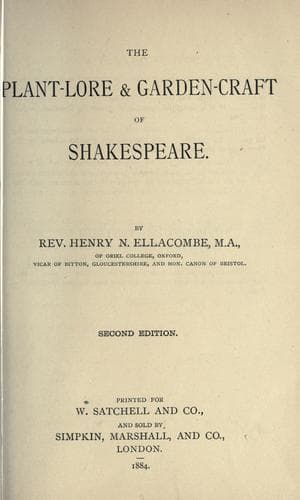
The plant-lore & garden-craft of ShakespeareEllacombe, Henry Nicholson
General
The plant-lore & garden-craft of Shakespeare
Ellacombe, Henry Nicholson
Gardens in literature; Plants in literature; Shakespeare, William, 1564-1616 -- Knowledge -- Botany
The history of the name is curious. The Sycomore, or Zicamine tree of
the Bible and of Theophrastus and Dioscorides, is the Fig-mulberry, a
large handsome tree indigenous in Africa and Syria, and largely planted,
partly for the sake of its fruit, and especially for the delicious shade
it gives. With this tree the early English writers were not acquainted,
but they found the name in the Bible, and applied it to any shade-giving
tree. Thus in Ælfric's Vocabulary in the tenth century it is given to
the Aspen--"Sicomorus vel celsa æps." Chaucer gives the name to some
hedge shrub, but he probably used it for any thick shrub, without any
very special distinction--
"The hedge also that yedde in compas
And closed in all the greene herbere
With Sicamour was set and Eglateere,
Wrethen in fere so well and cunningly
That every branch and leafe grew by measure
Plaine as a bord, of an height by and by."
_The Flower and the Leaf._
Our Sycamore would be very ill suited to make the sides and roof of an
arbour, but before the time of Shakespeare it seems certain that the
name was attached to our present tree, and it is so called by Gerard and
Parkinson.
The Sycamore is chiefly planted for its rapid growth rather than for
its beauty. It becomes a handsome tree when fully grown, but as a young
tree it is stiff and heavy, and at all times it is so infested with
honeydew as to make it unfit for planting on lawns or near paths. It
grows well in the north, where other trees will not well flourish, and
"we frequently meet with the tree apart in the fields, or unawares in
remote localities amidst the Lammermuirs and the Cheviots, where it is
the surviving witness of the former existence of a hamlet there. Hence
to the botanical rambler it has a more melancholy character than the
Yew. It throws him back on past days, when he who planted the tree was
the owner of the land and of the Hall, and whose name and race are
forgotten even by tradition. . . . And there is reasonable pride in the
ancestry when a grove of old gentlemanly Sycamores still shadows the
Hall."--JOHNSTON. But these old Sycamores were not planted only for
beauty: they were sometimes planted for a very unpleasant use. "They
were used by the most powerful barons in the West of Scotland for
hanging their enemies and refractory vassals on, and for this reason
were called _dool_ or grief trees. Of these there are three yet
standing, the most memorable being one near the fine old castle of
Cassilis, one of the seats of the Marquis of Ailsa, on the banks of the
River Doon. It was used by the family of Kennedy, who were the most
powerful barons of the West of Scotland, for the purpose above
mentioned."--JOHNS.
Public-domain text, read in full here on John Shaqi.
Reviews
Reviews
No reviews yet
Be the first to share your thoughts on this work.
Elsewhere in the archive
Join the Discussion
Join the discussion
Sign in to leave a comment or review.
Sign InorCreate an account