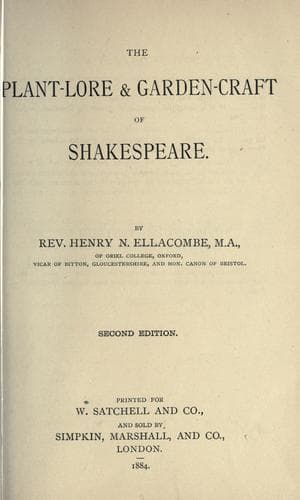
The plant-lore & garden-craft of ShakespeareEllacombe, Henry Nicholson
General
The plant-lore & garden-craft of Shakespeare
Ellacombe, Henry Nicholson
Gardens in literature; Plants in literature; Shakespeare, William, 1564-1616 -- Knowledge -- Botany
And in the introductory song to the "Two Noble Kinsmen," which is
claimed by some as Shakespeare's, we find among the other flowers of
spring--
"Daisies smel-lesse, yet most quaint."
These are the only places in which the Daisy is mentioned in
Shakespeare's plays, and it is a little startling to find that of these
six one is in a song for clowns, and two others are connected with the
poor mad princess. I hope that you will not use Shakespeare's authority
against me, that to talk of Daisies is only fit for clowns and madmen.
Contemporary with Shakespeare was Cutwode, who in the "Caltha Poetarum,"
published in 1599, thus describes the Daisy--
"On her attends the Daisie dearly dight
that pretty Primula of Lady Ver
As handmaid to her Mistresse day and night
so doth she watch, so waiteth she on her,
With double diligence, and dares not stir,
A fairer flower perfumes not forth in May
Then is this Daisie or this Primula.
About her neck she wears a rich wrought ruffe,
with double sets most brave and broad bespread,
Resembling lovely Lawn or Cambrick stuffe
pind up and prickt upon her yealow head,
Wearing her haire on both sides of her shead;
And with her countenance she hath acast
Wagging the wāton with each wynd and blast."
Stanza 21, 22.
Drayton, in the "Polyolbion," 15th Song, represents the Naiads engaged
in twining garlands for the marriage of Tame and Isis, and considering
that he--
"Should not be dressed with flowers to garden that belong
(His bride that better fitteth), but only such as spring
From the replenisht meads and fruitful pasture neere,"
they collect among other wild flowers--
"The Daysie over all those sundry sweets so thick
As nature doth herself, to imitate her right;
Who seems in that her pearle so greatly to delight
That every plaine therewith she powdereth to beholde."
And to the same effect, in his "Description of Elysium"--
"There Daisies damask every place,
Nor once their beauties lose,
That when proud Phœbus turns his face,
Themselves they scorn to close."
Browne, contemporary with Shakespeare, has these pretty lines on the
Daisy--
"The Daisy scattered on each mead and down,
A golden tuft within a silver crown;
(Fair fall that dainty flower! and may there be
No shepherd graced that doth not honour thee!)."
_Brit. Past._, ii. 3.
And the following must be about the same date--
"The pretty Daisy which doth show
Her love to Phœbus, bred her woe;
(Who joys to see his cheareful face,
And mournes when he is not in place)--
'Alacke! alacke! alacke!' quoth she,
'There's none that ever loves like me.'"
_The Deceased Maiden's Lover_--Roxburghe Ballads, i, 341.
Public-domain text, read in full here on John Shaqi.
Reviews
Reviews
No reviews yet
Be the first to share your thoughts on this work.
Elsewhere in the archive
Join the Discussion
Join the discussion
Sign in to leave a comment or review.
Sign InorCreate an account