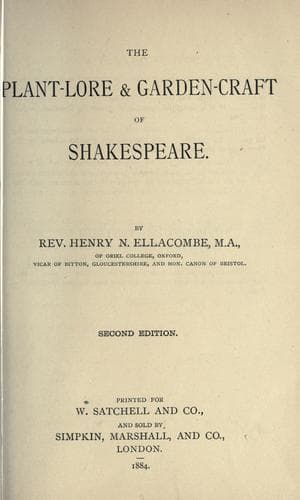
The plant-lore & garden-craft of ShakespeareEllacombe, Henry Nicholson
General
The plant-lore & garden-craft of Shakespeare
Ellacombe, Henry Nicholson
Gardens in literature; Plants in literature; Shakespeare, William, 1564-1616 -- Knowledge -- Botany
I am not surprised to find that Milton barely mentions the Daisy. His
knowledge of plants was very small compared to Shakespeare's, and seems
to have been, for the most part, derived from books. His descriptions of
plants all savour more of study than the open air. I only know of two
places in which he mentions the Daisy. In the "l'Allegro" he speaks of
"Meadows trim with Daisies pied," and in another place he speaks of
"Daisies trim." But I am surprised to find the Daisy overlooked by two
such poets as Robert Herrick and George Herbert. Herrick sang of flowers
most sweetly, few if any English poets have sung of them more sweetly,
but he has little to say of the Daisy. He has one poem, indeed,
addressed specially to a Daisy, but he simply uses the little flower,
and not very successfully, as a peg on which to hang the praises of his
mistress. He uses it more happily in describing the pleasures of a
country life--
"Come live with me and thou shalt see
The pleasures I'll prepare for thee,
What sweets the country can afford,
Shall bless thy bed and bless thy board.
. . . Thou shalt eat
The paste of Filberts for thy bread,
With cream of Cowslips buttered;
Thy feasting tables shall be hills,
With Daisies spread and Daffodils."
And again--
"Young men and maids meet,
To exercise their dancing feet,
Tripping the comely country round,
With Daffodils and Daisies crowned."
George Herbert had a deep love for flowers, and a still deeper love for
finding good Christian lessons in the commonest things about him. He
delights in being able to say--
"Yet can I mark how herbs below
Grow green and gay;"
but I believe he never mentions the Daisy.
Of the poets of the seventeenth century I need only make one short
quotation from Dryden--
"And then the band of flutes began to play,
To which a lady sang a tirelay:
And still at every close she would repeat
The burden of the song--'The Daisy is so sweet,
The Daisy is so sweet'--when she began
The troops of knights and dames continued on
The consort; and the voice so charmed my ear
And soothed my soul that it was heaven to hear."
Public-domain text, read in full here on John Shaqi.
Reviews
Reviews
No reviews yet
Be the first to share your thoughts on this work.
Elsewhere in the archive
Join the Discussion
Join the discussion
Sign in to leave a comment or review.
Sign InorCreate an account