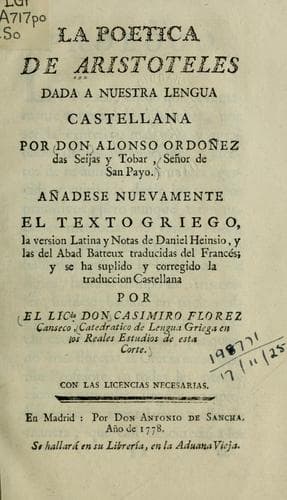
Aesthetics -- Early works to 1800; Poetry -- Early works to 1800
Unity of plot does not, as some persons think, consist in the Unity of
the hero. For infinitely various are the incidents in one man's life
which cannot be reduced to unity; and so, too, there are many actions of
one man out of which we cannot make one action. Hence, the error, as it
appears, of all poets who have composed a Heracleid, a Theseid, or other
poems of the kind. They imagine that as Heracles was one man, the story
of Heracles must also be a unity. But Homer, as in all else he is of
surpassing merit, here too--whether from art or natural genius--seems
to have happily discerned the truth. In composing the Odyssey he did not
include all the adventures of Odysseus--such as his wound on Parnassus,
or his feigned madness at the mustering of the host--incidents between
which there was no necessary or probable connection: but he made the
Odyssey, and likewise the Iliad, to centre round an action that in our
sense of the word is one. As therefore, in the other imitative arts, the
imitation is one when the object imitated is one, so the plot, being an
imitation of an action, must imitate one action and that a whole, the
structural union of the parts being such that, if any one of them is
displaced or removed, the whole will be disjointed and disturbed. For a
thing whose presence or absence makes no visible difference, is not an
organic part of the whole.
IX
It is, moreover, evident from what has been said, that it is not
the function of the poet to relate what has happened, but what may
happen,--what is possible according to the law of probability or
necessity. The poet and the historian differ not by writing in verse or
in prose. The work of Herodotus might be put into verse, and it would
still be a species of history, with metre no less than without it. The
true difference is that one relates what has happened, the other what
may happen. Poetry, therefore, is a more philosophical and a higher
thing than history: for poetry tends to express the universal, history
the particular. By the universal, I mean how a person of a certain type
will on occasion speak or act, according to the law of probability or
necessity; and it is this universality at which poetry aims in the names
she attaches to the personages. The particular is--for example--what
Alcibiades did or suffered. In Comedy this is already apparent: for here
the poet first constructs the plot on the lines of probability, and then
inserts characteristic names;--unlike the lampooners who write about
particular individuals. But tragedians still keep to real names, the
reason being that what is possible is credible: what has not happened
we do not at once feel sure to be possible: but what has happened is
manifestly possible: otherwise it would not have happened. Still there
are even some tragedies in which there are only one or two well known
names, the rest being fictitious. In others, none are well known, as in
Agathon's Antheus, where incidents and names alike are fictitious, and
Public-domain text, read in full here on John Shaqi.
Reviews
Reviews
No reviews yet
Be the first to share your thoughts on this work.
Join the Discussion
Join the discussion
Sign in to leave a comment or review.
Sign InorCreate an account