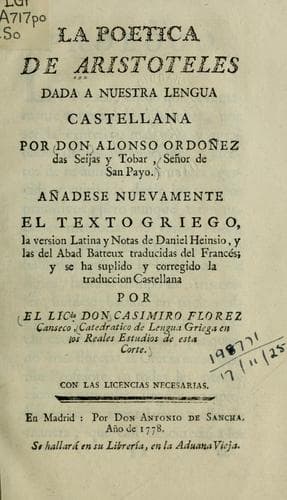
Aesthetics -- Early works to 1800; Poetry -- Early works to 1800
yet they give none the less pleasure. We must not, therefore, at all
costs keep to the received legends, which are the usual subjects of
Tragedy. Indeed, it would be absurd to attempt it; for even subjects
that are known are known only to a few, and yet give pleasure to all.
It clearly follows that the poet or 'maker' should be the maker of plots
rather than of verses; since he is a poet because he imitates, and what
he imitates are actions. And even if he chances to take an historical
subject, he is none the less a poet; for there is no reason why some
events that have actually happened should not conform to the law of the
probable and possible, and in virtue of that quality in them he is their
poet or maker.
Of all plots and actions the epeisodic are the worst. I call a plot
'epeisodic' in which the episodes or acts succeed one another without
probable or necessary sequence. Bad poets compose such pieces by their
own fault, good poets, to please the players; for, as they write show
pieces for competition, they stretch the plot beyond its capacity, and
are often forced to break the natural continuity.
But again, Tragedy is an imitation not only of a complete action, but of
events inspiring fear or pity. Such an effect is best produced when the
events come on us by surprise; and the effect is heightened when, at the
same time, they follow as cause and effect. The tragic wonder will thee
be greater than if they happened of themselves or by accident; for even
coincidences are most striking when they have an air of design. We may
instance the statue of Mitys at Argos, which fell upon his murderer
while he was a spectator at a festival, and killed him. Such events seem
not to be due to mere chance. Plots, therefore, constructed on these
principles are necessarily the best.
X
Plots are either Simple or Complex, for the actions in real life, of
which the plots are an imitation, obviously show a similar distinction.
An action which is one and continuous in the sense above defined, I call
Simple, when the change of fortune takes place without Reversal of the
Situation and without Recognition.
A Complex action is one in which the change is accompanied by such
Reversal, or by Recognition, or by both. These last should arise from
the internal structure of the plot, so that what follows should be the
necessary or probable result of the preceding action. It makes all the
difference whether any given event is a case of propter hoc or post hoc.
XI
Public-domain text, read in full here on John Shaqi.
Reviews
Reviews
No reviews yet
Be the first to share your thoughts on this work.
Join the Discussion
Join the discussion
Sign in to leave a comment or review.
Sign InorCreate an account