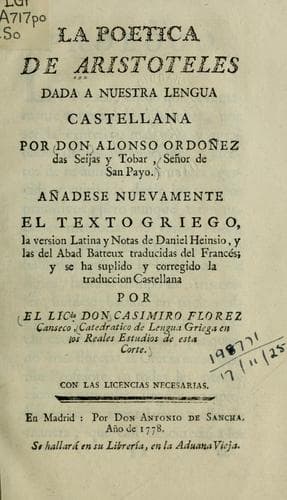
Aesthetics -- Early works to 1800; Poetry -- Early works to 1800
A well constructed plot should, therefore, be single in its issue,
rather than double as some maintain. The change of fortune should be not
from bad to good, but, reversely, from good to bad. It should come about
as the result not of vice, but of some great error or frailty, in a
character either such as we have described, or better rather than
worse. The practice of the stage bears out our view. At first the poets
recounted any legend that came in their way. Now, the best tragedies
are founded on the story of a few houses, on the fortunes of Alcmaeon,
Oedipus, Orestes, Meleager, Thyestes, Telephus, and those others who
have done or suffered something terrible. A tragedy, then, to be perfect
according to the rules of art should be of this construction. Hence
they are in error who censure Euripides just because he follows this
principle in his plays, many of which end unhappily. It is, as we have
said, the right ending. The best proof is that on the stage and in
dramatic competition, such plays, if well worked out, are the most
tragic in effect; and Euripides, faulty though he may be in the general
management of his subject, yet is felt to be the most tragic of the
poets.
In the second rank comes the kind of tragedy which some place first.
Like the Odyssey, it has a double thread of plot, and also an opposite
catastrophe for the good and for the bad. It is accounted the best
because of the weakness of the spectators; for the poet is guided in
what he writes by the wishes of his audience. The pleasure, however,
thence derived is not the true tragic pleasure. It is proper rather to
Comedy, where those who, in the piece, are the deadliest enemies--like
Orestes and Aegisthus--quit the stage as friends at the close, and no
one slays or is slain.
XIV
Fear and pity may be aroused by spectacular means; but they may also
result from the inner structure of the piece, which is the better way,
and indicates a superior poet. For the plot ought to be so constructed
that, even without the aid of the eye, he who hears the tale told will
thrill with horror and melt to pity at what takes place. This is the
impression we should receive from hearing the story of the Oedipus. But
to produce this effect by the mere spectacle is a less artistic method,
and dependent on extraneous aids. Those who employ spectacular means
to create a sense not of the terrible but only of the monstrous, are
strangers to the purpose of Tragedy; for we must not demand of Tragedy
any and every kind of pleasure, but only that which is proper to it. And
since the pleasure which the poet should afford is that which comes from
pity and fear through imitation, it is evident that this quality must be
impressed upon the incidents.
Let us then determine what are the circumstances which strike us as
terrible or pitiful.
Public-domain text, read in full here on John Shaqi.
Reviews
Reviews
No reviews yet
Be the first to share your thoughts on this work.
Join the Discussion
Join the discussion
Sign in to leave a comment or review.
Sign InorCreate an account