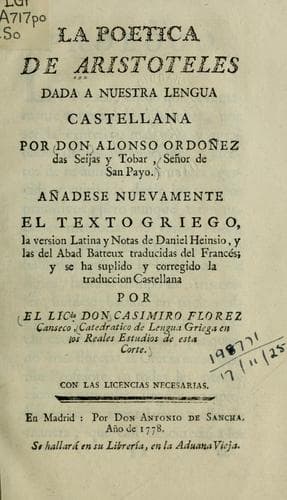
Aesthetics -- Early works to 1800; Poetry -- Early works to 1800
The Prologue is that entire part of a tragedy which precedes the Parode
of the Chorus. The Episode is that entire part of a tragedy which
is between complete choric songs. The Exode is that entire part of a
tragedy which has no choric song after it. Of the Choric part the Parode
is the first undivided utterance of the Chorus: the Stasimon is a Choric
ode without anapaests or trochaic tetrameters: the Commos is a joint
lamentation of Chorus and actors. The parts of Tragedy which must
be treated as elements of the whole have been already mentioned. The
quantitative parts the separate parts into which it is divided--are here
enumerated.]
XIII
As the sequel to what has already been said, we must proceed to consider
what the poet should aim at, and what he should avoid, in constructing
his plots; and by what means the specific effect of Tragedy will be
produced.
A perfect tragedy should, as we have seen, be arranged not on the simple
but on the complex plan. It should, moreover, imitate actions which
excite pity and fear, this being the distinctive mark of tragic
imitation. It follows plainly, in the first place, that the change, of
fortune presented must not be the spectacle of a virtuous man brought
from prosperity to adversity: for this moves neither pity nor fear; it
merely shocks us. Nor, again, that of a bad man passing from adversity
to prosperity: for nothing can be more alien to the spirit of Tragedy;
it possesses no single tragic quality; it neither satisfies the moral
sense nor calls forth pity or fear. Nor, again, should the downfall of
the utter villain be exhibited. A plot of this kind would, doubtless,
satisfy the moral sense, but it would inspire neither pity nor fear; for
pity is aroused by unmerited misfortune, fear by the misfortune of a man
like ourselves. Such an event, therefore, will be neither pitiful
nor terrible. There remains, then, the character between these two
extremes,--that of a man who is not eminently good and just,-yet whose
misfortune is brought about not by vice or depravity, but by some error
or frailty. He must be one who is highly renowned and prosperous,--a
personage like Oedipus, Thyestes, or other illustrious men of such
families.
Public-domain text, read in full here on John Shaqi.
Reviews
Reviews
No reviews yet
Be the first to share your thoughts on this work.
Join the Discussion
Join the discussion
Sign in to leave a comment or review.
Sign InorCreate an account