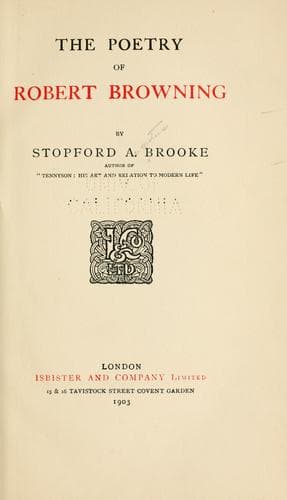
The poetry of Robert BrowningBrooke, Stopford A. (Stopford Augustus)
General
The poetry of Robert Browning
Brooke, Stopford A. (Stopford Augustus)
Browning, Robert, 1812-1889 -- Criticism and interpretation
As long as this vivid representation of actual human life lasted, the
art of the Renaissance was active, original, and interesting; and as it
moved on, developing into higher and finer forms, and producing
continually new varieties in its development, it reached its strong and
eager manhood. In its art then, as well as in other matters, the
Renaissance completed its new and clear theory of life; it remade the
grounds of life, of its action and passion; and it reconstituted its
aims. Browning loved this summer time of the Renaissance, which began
with the midst of the fifteenth century. But he loved its beginnings
even more than its fulness. That was characteristic. I have said that
even when he was eighty years old, his keenest sympathies were with
spring rather than summer, with those times of vital change when fresh
excitements disturbed the world, when its eyes were smiling with hope,
and its feet eager with the joy of pursuit. He rejoiced to analyse and
embody a period which was shaking off the past, living intensely in the
present, and prophesying the future. It charms us, as we read him, to
see his intellect and his soul like two hunting dogs, and with all their
eagerness, questing, roving, quartering, with the greatest joy and in
incessant movement, over a time like this, where so many diverse,
clashing, and productive elements mingled themselves into an enchanting
confusion and glory of life. Out of that pleasure of hunting in a
morning-tide of humanity, was born _Fra Lippo Lippi_; and there is
scarcely an element of the time, except the political elements, which it
does not represent; not dwelt on, but touched for the moment and left;
unconsciously produced as two men of the time would produce them in
conversation. The poem seems as easy as a chat in Pall Mall last night
between some intelligent men, which, read two hundred years hence, would
inform the reader of the trend of thought and feeling in this present
day. But in reality to do this kind of thing well is to do a very
difficult thing. It needs a full knowledge, a full imagination and a
masterly execution. Yet when we read the poem, it seems as natural as
the breaking out of blossoms. This is that divine thing, the ease of
genius.
Public-domain text, read in full here on John Shaqi.
Reviews
Reviews
No reviews yet
Be the first to share your thoughts on this work.
Elsewhere in the archive
Join the Discussion
Join the discussion
Sign in to leave a comment or review.
Sign InorCreate an account