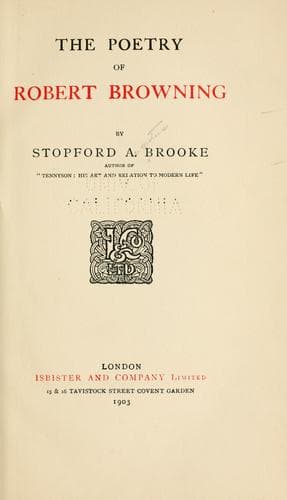
The poetry of Robert BrowningBrooke, Stopford A. (Stopford Augustus)
General
The poetry of Robert Browning
Brooke, Stopford A. (Stopford Augustus)
Browning, Robert, 1812-1889 -- Criticism and interpretation
A just appreciation of the work which Browning published after _The Ring
and the Book_ is a difficult task. The poems are of various kinds, on
widely separated subjects; and with the exception of those which treat
of Balaustion, they have no connection with one another. Many of them
must belong to the earlier periods of his life, and been introduced into
the volumes out of the crowd of unpublished poems every poet seems to
possess. These, when we come across them among their middle-aged
companions, make a strange impression, as if we found a white-thorn
flowering in an autumnal woodland; and in previous chapters of this book
I have often fetched them out of their places, and considered them where
they ought to be--in the happier air and light in which they were born.
I will not discuss them again, but in forming any judgment of the later
poems they must be discarded.
The struggle to which I have drawn attention between the imaginative and
intellectual elements in Browning, and which was equally balanced in
_The Ring and the Book_, continued after its publication, but with a
steady lessening of the imaginative and a steady increase of the
intellectual elements. One poem, however, written before the publication
of _The Ring and the Book_, does not belong to this struggle. This is
_Hervé Riel_, a ballad of fire and joy and triumph. It is curiously
French in sentiment and expression, and the eager sea-delight in it is
plainly French, not English in feeling. Nor is it only French; it is
Breton in audacity, in self-forgetfulness, in carelessness of reward,
and in loyalty to country, to love and to home. If Browning had been all
English, this transference of himself into the soul of another
nationality would have been wonderful, nay, impossible. As it is, it is
wonderful enough; and this self-transference--one of his finest poetic
powers--is nowhere better accomplished than in this poem, full of the
salt wind and the leap and joy of the sea-waves; but even more full, as
was natural to Browning, of the Breton soul of Hervé Riel.
Public-domain text, read in full here on John Shaqi.
Reviews
Reviews
No reviews yet
Be the first to share your thoughts on this work.
Elsewhere in the archive
Join the Discussion
Join the discussion
Sign in to leave a comment or review.
Sign InorCreate an account