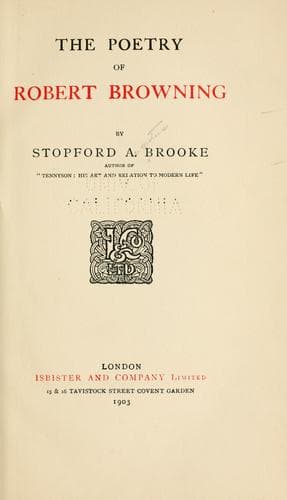
The poetry of Robert BrowningBrooke, Stopford A. (Stopford Augustus)
General
The poetry of Robert Browning
Brooke, Stopford A. (Stopford Augustus)
Browning, Robert, 1812-1889 -- Criticism and interpretation
In _Balaustion's Adventure_ (1871) which next appeared, the imaginative
elements, as we have seen, are still alive and happy; and though they
only emerge at intervals in its continuation, _Aristophanes' Apology_
(1875), yet they do emerge. Meanwhile, between _Balaustion's Adventure_
and the end of 1875, he produced four poems--_Prince Hohenstiel-Schwangau,
Saviour of Society_; _Fifine at the Fair_; _Red Cotton Nightcap
Country_, or _Turf and Towers_; and _The Inn Album_. They are all long,
and were published in four separate volumes. In them the intellectual
elements have all but completely conquered the imaginative. They are,
however, favourite "exercise-places" for some of his admirers, who think
that they derive poetic pleasures from their study. The pleasure these
poems give, when they give it, is not altogether a poetic pleasure. It
is chiefly the pleasure of the understanding called to solve with
excitement a huddle of metaphysical problems. They have the name but not
the nature of poetry.
They are the work of my Lord Intelligence--attended by wit and
fancy--who sits at the desk of poetry, and with her pen in his hand. He
uses the furniture of poetry, but the goddess herself has left the room.
Yet something of her influence still fills the air of the chamber. In
the midst of the brilliant display that fancy, wit, and intellect are
making, a soft steady light of pure song burns briefly at intervals, and
then is quenched; like the light of stars seen for a moment of quiet
effulgence among the crackling and dazzling of fireworks.
The poems are, it is true, original. We cannot class them with any
previous poetry. They cannot be called didactic or satirical. The
didactic and satirical poems of England are, for the most part,
artificial, concise, clear. These poems are not artificial, clear or
concise. Nor do they represent the men and women of a cultured,
intellectual and conventional society, such as the poetry of Dryden and
Pope addressed. The natural man is in them--the crude, dull, badly-baked
man--what the later nineteenth century called the real man. We see his
ugly, sordid, contemptible, fettered soul, and long for Salinguerra, or
Lippo Lippi, or even Caliban. The representations are then human enough,
with this kind of humanity, but they might have been left to prose.
Poetry has no business to build its houses on the waste and leprous
lands of human nature; and less business to call its work art. Realism
of this kind is not art, it is science.
Public-domain text, read in full here on John Shaqi.
Reviews
Reviews
No reviews yet
Be the first to share your thoughts on this work.
Elsewhere in the archive
Join the Discussion
Join the discussion
Sign in to leave a comment or review.
Sign InorCreate an account