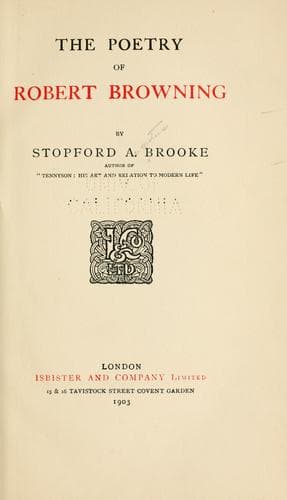
The poetry of Robert BrowningBrooke, Stopford A. (Stopford Augustus)
General
The poetry of Robert Browning
Brooke, Stopford A. (Stopford Augustus)
Browning, Robert, 1812-1889 -- Criticism and interpretation
The poems that follow these four volumes are mixed work, half
imaginative, half intellectual. Sometimes both kinds are found,
separated, in the same poem; sometimes in one volume half the poems will
be imaginative and the other half not. Could the imaginative and
intellectual elements have now been fused as they were in his earlier
work, it were well; but they were not. They worked apart. His witful
poems are all wit, his analytical poems are all analysis, and his
imaginative poems, owing to this want of fusion, have not the same
intellectual strength they had in other days. _Numpholeptos_, for
instance, an imaginative poem, full too of refined and fanciful emotion,
is curiously wanting in intellectual foundation.
The _Numpholeptos_ is in the volume entitled _Pacchiarotto, and how he
worked in Distemper_. Part of the poems in it are humorous, such as
_Pacchiarotto_ and _Filippo Baldinucci_, excellent pieces of agreeable
wit, containing excellent advice concerning life. One reads them, is
amused by them, and rarely desires to read them again. In the same
volume there are some severe pieces, sharply ridiculing his critics. In
the old days, when he wrote fine imaginative poetry, out of his heart
and brain working together, he did not mind what the critics said, and
only flashed a scoff or two at them in his creation of Naddo in
_Sordello_. But now when he wrote a great deal of his poetry out of his
brain alone, he became sensitive to criticism. For that sort of poetry
does not rest on the sure foundation which is given by the consciousness
the imagination has of its absolute rightness. He expresses his needless
soreness with plenty of wit in _Pacchiarotto_ and in the _Epilogue_,
criticises his critics, and displays his good opinion of his work--no
doubt of these later poems, like _The Inn Album_ and the rest--with a
little too much of self-congratulation. "The poets pour us wine," he
says, "and mine is strong--the strong wine of the loves and hates and
thoughts of man. But it is not sweet as well, and my critics object.
Were it so, it would be more popular than it is. Sweetness and strength
do not go together, and I have strength."
But that is not the real question. The question is--Is the strength
poetical? Has it imagination? It is rough, powerful, full of humanity,
and that is well. But is it half prose, or wholly prose? Or is it
poetry, or fit to be called so? He thinks that _Prince Hohenstiel_, or
_Red Cotton Nightcap Country_, are poetry. They are, it is true, strong;
and they are not sweet. But have they the strength of poetry in them,
and not the strength of something else altogether? That is the question
he ought to have answered, and it does not occur to him.
Public-domain text, read in full here on John Shaqi.
Reviews
Reviews
No reviews yet
Be the first to share your thoughts on this work.
Elsewhere in the archive
Join the Discussion
Join the discussion
Sign in to leave a comment or review.
Sign InorCreate an account