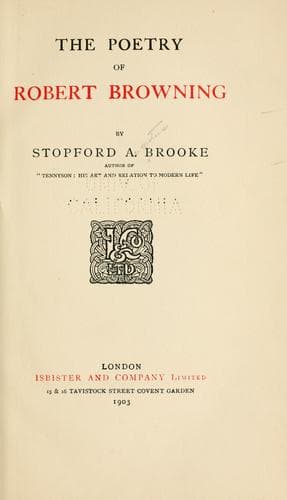
The poetry of Robert BrowningBrooke, Stopford A. (Stopford Augustus)
General
The poetry of Robert Browning
Brooke, Stopford A. (Stopford Augustus)
Browning, Robert, 1812-1889 -- Criticism and interpretation
Yet, he was, in this very book, half-way out of this muddle. There are
poems in it, just as strong as _The Inn Album_, but with the ineffable
spirit of imaginative emotion and thought clasped together in them, so
that the strong is stronger, and the humanity deeper than in the pieces
he thought, being deceived by the Understanding, were more strong than
the poems of old. In _Bifurcation_, in _St. Martin's Summer_, the
diviner spirit breathes. There is that other poem called _Forgiveness_
of which I have already spoken--one of his masterpieces. _Cenciaja_,
which may be classed with _Forgiveness_ as a study of the passion of
hatred, is not so good as its comrade, but its hatred is shown in a mean
character and for a meaner motive. And the _Prologue_, in its rhythm and
pleasure, its subtlety of thought, its depth of feeling, and its close
union of both, recalls his earlier genius.
The first of the _Pisgah Sights_ is a jewel. It is like a poem by
Goethe, only Goethe would have seen the "sight" not when he was dying,
but when he was alive to his finger-tips. The second is not like
Goethe's work, nor Browning's; but it is a true picture of what many
feel and are. So is _Fears and Scruples_. As to _Natural Magic_, surely
it is the most charming of compliments, most enchantingly expressed.
The next volume of original poems was _La Saisiaz_ and the _Two Poets of
Croisic_. The _Croisic Poets_ are agreeable studies, written with verve
and lucidity, of two fantastic events which lifted these commonplace
poets suddenly into fame. They do well to amuse an idle hour. The end of
both is interesting. That of the first, which begins with stanza lix.,
discusses the question: "Who cares, how such a mediocrity as René lived
after the fame of his prophecy died out?"[11] And Browning answers--
Well, I care--intimately care to have
Experience how a human creature felt
In after life, who bore the burthen grave
Of certainly believing God had dealt
For once directly with him: did not rave
--A maniac, did not find his reason melt
--An idiot, but went on, in peace or strife,
The world's way, lived an ordinary life.
The solution Browning offers is interesting, because it recalls a part
of the experiences of Lazarus in the _Epistle to Karshish_. René, like
Lazarus, but only for a moment, has lived in the eternal.
Are such revelations possible, is his second question. Yes, he answers;
and the form of the answer belongs to the theory of life laid down in
_Paracelsus_. Such sudden openings of the greater world are at
intervals, as to Abt Vogler, given by God to men.
Public-domain text, read in full here on John Shaqi.
Reviews
Reviews
No reviews yet
Be the first to share your thoughts on this work.
Elsewhere in the archive
Join the Discussion
Join the discussion
Sign in to leave a comment or review.
Sign InorCreate an account