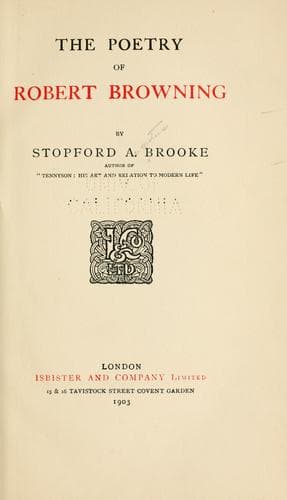
The poetry of Robert BrowningBrooke, Stopford A. (Stopford Augustus)
General
The poetry of Robert Browning
Brooke, Stopford A. (Stopford Augustus)
Browning, Robert, 1812-1889 -- Criticism and interpretation
The end of the second asks what is the true test of the greater poet,
when people take on them to weigh the worth of poets--who was better,
best, this, that or the other bard? When I read this I trembled, knowing
that I had compared him with Tennyson. But when I heard the answer I
trembled no more. "The best poet of any two is the one who leads the
happier life. The strong and joyful poet is the greater." But this is a
test of the greatness of a man, not necessarily of a poet. And,
moreover, in this case, Tennyson and Browning both lived equally happy
lives. Both were strong to the end, and imaginative joy was their
companion. But the verse in which Browning winds up his answer is one of
the finest in his poetry.
So, force is sorrow, and each sorrow, force;
What then? since Swiftness gives the charioteer
The palm, his hope be in the vivid horse
Whose neck God clothed with thunder, not the steer
Sluggish and safe! Yoke Hatred, Crime, Remorse,
Despair; but ever mid the whirling fear,
Let, through the tumult, break the poet's face
Radiant, assured his wild slaves win the race!
_La Saisiaz_ is a more important poem: it describes the sudden death of
his friend, Ann Egerton Smith, and passes from that, and all he felt
concerning it, into an argument on the future life of the soul, with the
assumption that God is, and the soul. The argument is interesting, but
does not concern us here. What does concern us is that Browning has
largely recovered his poetical way of treating a subject. He is no
longer outside of it, but in it. He does not use it as a means of
exercising his brains only. It is steeped in true and vital feeling, and
the deep friendship he had for his friend fills even the theological
argument with a passionate intensity. Nevertheless, the argument is
perilously near the work of the understanding alone--as if a question
like that of immortality could receive any solution from the hands of
the understanding. Only each man, in the recesses of his own spirit with
God, can solve that question for himself, and not for another. That is
Browning's position when he writes as a poet, and no one has written
more positively on the subject. But when he submits the question to
reasoning, he wavers, as he does here, and leaves the question more
undecided than anywhere else in his work. This is a pity, but it is the
natural penalty of his partial abandonment of the poetic for the prosaic
realm, of the imagination for the understanding, of the Reason for
reasoning.
FOOTNOTES:
[11] René Gentilhomme, page to Prince Condé, heir of France since Louis
XIII. and his brother Gaston were childless, is surprised, while writing
a love poem, by a lightning flash which shatters a marble ducal crown.
He thinks this a revelation from God, and he prophecies that a Dauphin
will be born to the childless Queen. The Dauphin was born, and René
pushed suddenly into fame.
* * * * *
Public-domain text, read in full here on John Shaqi.
Reviews
Reviews
No reviews yet
Be the first to share your thoughts on this work.
Elsewhere in the archive
Join the Discussion
Join the discussion
Sign in to leave a comment or review.
Sign InorCreate an account