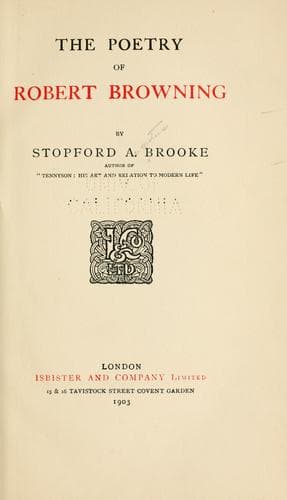
The poetry of Robert BrowningBrooke, Stopford A. (Stopford Augustus)
General
The poetry of Robert Browning
Brooke, Stopford A. (Stopford Augustus)
Browning, Robert, 1812-1889 -- Criticism and interpretation
CHAPTER XVIII
_THE LAST POEMS_
Two Volumes of Dramatic Idyls, one in 1879, the other in 1880, followed
_La Saisiaz_ and _The Two Poets of Croisic_. These are also mixed books,
composed, partly of studies of character written in rhythmical prose,
and partly of poems wrought out of the pure imagination. Three of
them--if they were written at this time--show how the Greek legends
still dwelt with Browning; and they brought with them the ocean-scent,
heroic life, and mythical charm of Athenian thought. It would be
difficult, if one could write of them at all, not to write of them
poetically; and _Pheidippides, Echetlos, Pan and Luna_ are alive with
force, imaginative joy, and the victorious sense the poet has of having
conquered his material. _Pheidippides_ is as full of fire, of careless
heroism as _Hervé Riel_, and told in as ringing verse. The versing of
_Echetlos_, its rugged, rousing sound, its movement, are in most
excellent harmony with the image of the rude, giant "Holder of the
ploughshare," who at Marathon drove his furrows through the Persians and
rooted up the Mede. Browning has gathered into one picture and one sound
the whole spirit of the story. _Pan and Luna_ is a bold re-rendering of
the myth that Vergil enshrines, and the greater part of it is of such
poetic freshness that I think it must be a waif from the earlier years
of his poetry. Nor is there better imaginative work in his descriptive
poetry than the image of the naked moon, in virginal distress, flying
for refuge through the gazing heaven to the succourable cloud--fleece on
fleece of piled-up snow, drowsily patient--where Pan lay in ambush for
her beauty.
Among these more gracious idyls, one of singular rough power tells the
ghastly tale of the mother who gave up her little children to the wolves
to save herself. Browning liked this poem, and the end he added to the
story--how the carpenter, Ivan, when the poor frightened woman
confessed, lifted his axe and cut off her head; how he knew that he did
right, and was held to have done right by the village and its pope. The
sin by which a mother sacrificed the lives of her children to save her
own was out of nature: the punishment should be outside of ordinary law.
It is a piteous tale, and few things in Browning equal the horror of the
mother's vain attempt to hide her crime while she confesses it. Nor does
he often show greater imaginative skill in metrical movement than when
he describes in galloping and pattering verse the grey pack emerging
from the forest, their wild race for the sledge, and their demon leader.
Public-domain text, read in full here on John Shaqi.
Reviews
Reviews
No reviews yet
Be the first to share your thoughts on this work.
Elsewhere in the archive
Join the Discussion
Join the discussion
Sign in to leave a comment or review.
Sign InorCreate an account