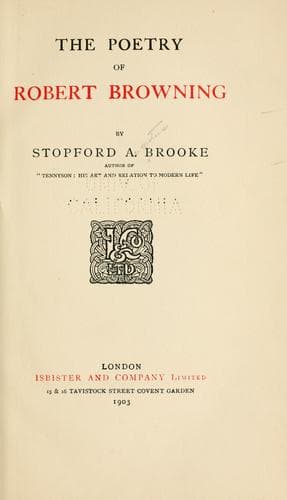
The poetry of Robert BrowningBrooke, Stopford A. (Stopford Augustus)
General
The poetry of Robert Browning
Brooke, Stopford A. (Stopford Augustus)
Browning, Robert, 1812-1889 -- Criticism and interpretation
The other idyls in these two volumes are full of interest for those who
care for psychological studies expressed in verse. What the vehicle of
verse does for them is to secure conciseness and suggestiveness in the
rendering of remote, daring, and unexpected turns of thought and
feeling, and especially of conscience. Yet the poems themselves cannot
be called concise. Their subjects are not large enough, nor indeed
agreeable enough, to excuse their length. Goethe would have put them
into a short lyrical form. It is impossible not to regret, as we read
them, the Browning of the _Dramatic Lyrics_. Moreover, some of them are
needlessly ugly. _Halbert and Hob_--and in _Jocoseria_--_Donald_, are
hateful subjects, and their treatment does not redeem them; unlike the
treatment of _Ivan Ivanovitch_ which does lift the pain of the story
into the high realms of pity and justice. Death, swift death, was not
only the right judgment, but also the most pitiful. Had the mother
lived, an hour's memory would have been intolerable torture.
Nevertheless, if Browning, in his desire to represent the whole of
humanity, chose to treat these lower forms of human nature, I suppose we
must accept them as an integral part of his work; and, at least, there
can be no doubt of their ability, and of the brilliancy of their
psychological surprises. _Ned Bratts_ is a monument of cleverness, as
well as of fine characterisation of a momentary outburst of conscience
in a man who had none before; and who would have lost it in an hour, had
he not been hanged on the spot. The quick, agile, unpremeditated turns
of wit in this poem, as in some of the others, are admirably easy, and
happily expressed. Indeed, in these later poems of character and event,
ingenuity or nimbleness of intellect is the chief element, and it is
accompanied by a facile power which is sometimes rude, often careless,
always inventive, fully fantastical, and rarely imaginative in the
highest sense of the word. Moreover, as was not the case of old, they
have, beyond the story, a direct teaching aim, which, while it lowers
them as art, is very agreeable to the ethical psychologist.
Public-domain text, read in full here on John Shaqi.
Reviews
Reviews
No reviews yet
Be the first to share your thoughts on this work.
Elsewhere in the archive
Join the Discussion
Join the discussion
Sign in to leave a comment or review.
Sign InorCreate an account