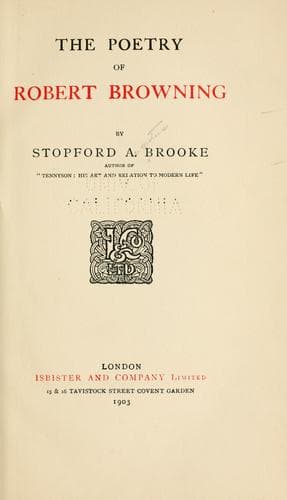
The poetry of Robert BrowningBrooke, Stopford A. (Stopford Augustus)
General
The poetry of Robert Browning
Brooke, Stopford A. (Stopford Augustus)
Browning, Robert, 1812-1889 -- Criticism and interpretation
_Jocoseria_ has poems of a higher quality, some of which, like the
lovely _Never the Time and Place_, I have been already quoted. _Ixion_
is too obscurely put to attain its end with the general public. But it
may be recommended, though vainly, to those theologians who, hungry for
the Divine Right of torture, build their God, like Caliban, out of their
own minds; who, foolish enough to believe that the everlasting endurance
of evil is a necessary guarantee of the everlasting endurance of good,
are still bold and bad enough to proclaim the abominable lie of eternal
punishment. They need that spirit the little child whom Christ placed in
the midst of his disciples; and in gaining which, after living the life
of the lover, the warrior, the poet, the statesman, _Jochanan Hakkadosh_
found absolute peace and joy. Few poems contain more of Browning's
matured theory of life than this of the Jewish Rabbi; and its
seriousness is happily mingled with imaginative illustrations and with
racy wit. The sketch of Tsaddik, who puts us in mind of Wagner in the
_Faust_, is done with a sarcastic joy in exposing the Philistine, and
with a delight in its own cleverness which is fascinating.
_Ferishtah's Fancies_ and _Parleyings with Certain People_ followed
_Jocoseria_ in 1884 and 1887. The first of these books is much the
better of the two. A certain touch of romance is given by the Dervish,
by the Fables with which he illustrates his teaching, and by the Eastern
surroundings. Some of the stories are well told, and their scenery is
truthfully wrought and in good colour. The subjects are partly
theological, with always a reference to human life; and partly of the
affections and their working. It is natural to a poet, and delightful in
Browning, to find him in his old age dwelling from poem to poem on the
pre-eminence of love, on love as the ultimate judge of all questions. He
asserts this again and again; with the greatest force in _A Pillar at
Sebzevar_, and, more lightly, in _Cherries_. Yet, and this is a pity, he
is not satisfied with the decision of love, but spends pages in
argumentative discussions which lead him away from that poetical
treatment of the subjects which love alone, as the master, would have
enabled him to give. However, the treatment that love gives we find in
the lyrics at the end of each _Fancy_; and some of these lyrics are of
such delicate and subtle beauty that I am tempted to think that they
were written at an earlier period, and their _Fancies_ composed to fit
them. If they were written now, it is plain that age had not disenabled
him from walking with pleasure and power among those sweet, enamelled
meadows of poetry in whose soil he now thought great poetry did not
grow. And when we read the lyrics, our regret is all the more deep that
he chose the thorn-clad and desert lands, where barren argument goes
round and round its subjects without ever finding the true path to their
centre.
Public-domain text, read in full here on John Shaqi.
Reviews
Reviews
No reviews yet
Be the first to share your thoughts on this work.
Elsewhere in the archive
Join the Discussion
Join the discussion
Sign in to leave a comment or review.
Sign InorCreate an account