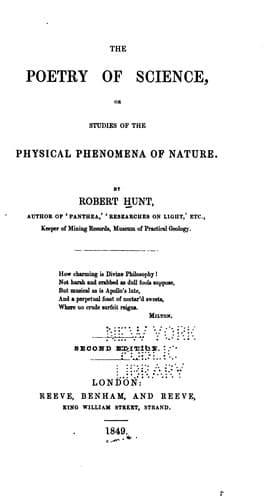
The Poetry of Science; or, Studies of the Physical Phenomena of NatureHunt, Robert
Philosophy
The Poetry of Science; or, Studies of the Physical Phenomena of Nature
Hunt, Robert
Physics; Science
All the planets of our system shine with reflected light, and the
moon, our satellite, also owes her silvery lustre to the sun’s
radiations. The fixed stars are, in all probability, suns shining from
the far distance of space, with their own self-emitted lights. By the
photometric researches of Dr. Wollaston, we learn, however, that it
would take 20,000 millions of such orbs as Sirius, the brightest of the
fixed stars, to afford as much light as we derive from the sun. The
same observer has proved that the brightest effulgence of the full moon
is yet 801,072 times less than the luminous power of our solar centre.
The cultivators of modern science are a bold race; not contented with
endeavouring to understand the physical earth, they are endeavouring
to comprehend the condition of the solar surface. The mind of man can
penetrate far into nature, and, as it were, feel out the mysteries of
untraversed space. The astronomer learns of a peculiar condition of
light, which is termed polarisation, and he learns by this, too, that
he can determine if from a bright luminous disc the light is derived
from a solid mass in a state of intense ignition, or from vapour in
an incandescent condition. He adds a polarising apparatus to his
telescopes, and he determines that the light we derive from the sun
is due to an envelope of vapour--burning, in all probability--only
with greater intensity, as the gas which we now employ. This
_Photosphere_--as it has been called by the late French philosopher
Arago, is found to be subjected to violent disturbances, and the dark
spots seen on the sun’s disc are now known to be openings through this
mysterious envelope of light, which enable us to look in upon the dark
body of the sun itself.
Luminous phenomena may be produced by various means--chemical action
is a source of light; and, under several circumstances in which the
laws of affinity are strongly exerted, a very intense luminous effect
is produced. Under this head all the phenomena of combustion are
included. In the electric spark we have the development of light;
and the arc which is formed between charcoal points at the poles of
a powerful voltaic battery affords us the most intense artificial
illumination with which we are acquainted. In addition to these, we
have the peculiar phenomena of phosphorescence arising from chemical,
calorific, electrical, actinic, and vital excitation, all of which must
be particularly examined.
From whatever source we procure light, it is the same in character,
differing only in intensity. In its action upon matter, we have the
phenomena of transmission, of reflection, of refraction, of colour, of
polarisation, and of vision, to engage our attention.
Public-domain text, read in full here on John Shaqi.
Reviews
Reviews
No reviews yet
Be the first to share your thoughts on this work.
Elsewhere in the archive
Join the Discussion
Join the discussion
Sign in to leave a comment or review.
Sign InorCreate an account