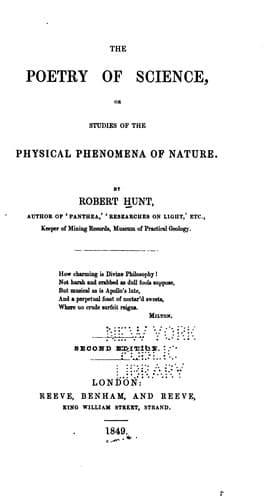
The Poetry of Science; or, Studies of the Physical Phenomena of NatureHunt, Robert
Philosophy
The Poetry of Science; or, Studies of the Physical Phenomena of Nature
Hunt, Robert
Physics; Science
A beam of white light falls upon a plate of colourless glass, and it
passes freely through it, losing but little of its intensity; the
largest portion being lost by reflection from the first surface upon
which the light impinges. If the glass is roughened by grinding, we
lose more light by absorption and by reflection from the asperities of
the roughened surface; but if we cover that face with any oleaginous
fluid, as, for instance, turpentine, its transparency is restored. We
have thus direct proof that transparency to light is due to molecular
condition. This may be most strikingly shown by an interesting
experiment of Sir David Brewster’s:--
If a glass tube is filled with nitrous acid vapour, which is of a dull
red colour, it admits freely the passage of the red and orange rays
with some of the others, and, if held upright in the sunshine, casts
a red shadow on the ground; by gently warming it with a spirit-lamp,
whilst in this position, it acquires a much deeper and blacker colour,
and becomes almost impervious to any of the rays of light; but upon
cooling it again recovers its transparency.
It has also been stated by the same exact experimentalist, that having
brought a purple glass to a red heat, its transparency was improved, so
that it transmitted green, yellow, and red rays, which it previously
absorbed; but the glass recovered its absorptive powers as it cooled.
A piece of yellowish-green glass lost its transparency almost entirely
by being heated. Native yellow orpiment becomes blood-red upon being
warmed, when nearly all but the red rays are absorbed; and pure
phosphorus, which is of a pale yellow colour, and transmits freely all
the coloured rays upon being melted, becomes very dark, and transmits
no light.
Chemistry affords numerous examples of a very slight change of
condition, producing absolute opacity in fluids which were previously
diaphanous.[88]
Charcoal absorbs all the light which falls upon it, but in some
of its states of combination, and in the diamond, which is pure
carbon, it is highly transparent. Gold and silver beaten into thin
leaves are permeated by the green and blue rays, and the metals in
combination with acids are all of them more or less transparent. What
becomes of the light which falls upon and is absorbed by bodies,
is a question which we cannot yet, notwithstanding the extensive
observations that have been made by some of the most gifted of men,
answer satisfactorily. In all probability, as already stated, it
is permanently retained within their substances; and many of the
experiments of exciting light in bodies when in perfect darkness, by
the electric spark and other means, appear to support the idea of light
becoming latent or hidden.
No body is absolutely transparent; some light is lost in passing even
through ethereal space, and still more in traversing our atmosphere.
Public-domain text, read in full here on John Shaqi.
Reviews
Reviews
No reviews yet
Be the first to share your thoughts on this work.
Elsewhere in the archive
Join the Discussion
Join the discussion
Sign in to leave a comment or review.
Sign InorCreate an account