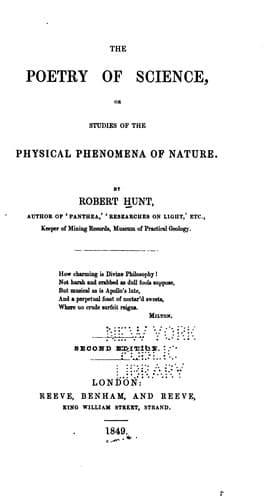
The Poetry of Science; or, Studies of the Physical Phenomena of NatureHunt, Robert
Philosophy
The Poetry of Science; or, Studies of the Physical Phenomena of Nature
Hunt, Robert
Physics; Science
Amongst the most curious instances of absorption is that which is
uniformly discovered in the solar spectrum, particularly when we
examine it with a telescope. We then find that the coloured rays are
crossed by a great number of dark bands or lines, giving no light;
these are generally called Fraunhofer’s dark lines, as it was to the
indefatigable exertions of that experimentalist, and by the aid of his
beautiful instruments, that most of them were discovered and measured,
and enumerated, although they were previously noticed by Dr. Wollaston.
It is quite clear that those lines represent rays which have been
absorbed in their passage from the sun to the earth: although some
of them have no doubt undergone absorption within the limits of the
earth’s atmosphere, we have every reason to believe, with Sir John
Herschel, that the principal absorption takes place in the atmosphere
of the sun.[89]
It has been proved by Dr. Miller, that the number of those dark
lines is continually varying with the alteration of atmospheric
conditions;[90] and the evidences which have been afforded, of peculiar
states of absorption by the gaseous envelope of the earth,--during the
prosecution of investigations on the chemical agencies of the sun’s
rays,--are of a sufficiently convincing character.
It has been calculated by Bouguer, that if our atmosphere, in its
purest state, could be extended rather more than 700 miles from the
earth’s surface instead of nearly 40, as it is at present, the sun’s
rays could not penetrate it, and this globe would roll on in darkness
and silence, without a vestige of vegetable form or of animal life. In
the Hebrew version of the Mosaic History, the reading is, “Let light
appear:” may not this really mean that the earth’s atmosphere was so
cleared of obstructing vapours, that the solar rays were enabled to
reach the earth? The same calculation supposes that sea-water loses
all its transparency at the depth of 730 feet; but a dim twilight must
prevail much deeper in the ocean.
The researches of Professor Edward Forbes have proved, that at the
depth of 230 fathoms in the Ægean sea, the few shelled animals that
exist are colourless: no plants are found within that zone; and that
industrious naturalist fixes the zero of animal life of those waters at
about 300 fathoms.[91] Since these zones mark the rapidly diminishing
light, it is evident that where life ceases to be must be beyond the
limits to which life can penetrate.
Our atmosphere, charged with aqueous vapour, serves to shield us from
the intense action of the solar powers. By it we are protected from
the destructive influences of the sun’s light and heat; enjoy those
modified conditions which are most conducive to the healthful being of
organic forms; to it we owe “the blue sky bending over all,” and those
beauties of morning and evening twilight of which
---- Sound and motion own the potent sway.
Responding to the charm with its own mystery.
Public-domain text, read in full here on John Shaqi.
Reviews
Reviews
No reviews yet
Be the first to share your thoughts on this work.
Elsewhere in the archive
Join the Discussion
Join the discussion
Sign in to leave a comment or review.
Sign InorCreate an account