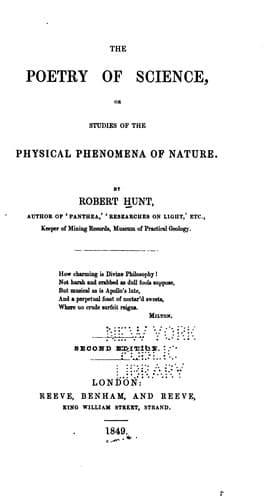
The Poetry of Science; or, Studies of the Physical Phenomena of NatureHunt, Robert
Philosophy
The Poetry of Science; or, Studies of the Physical Phenomena of Nature
Hunt, Robert
Physics; Science
To defective transparency, or rather to the different degrees of it, we
must attribute, in part, the colours of permeable media. Thus, a glass
or fluid appears yellow to the eye, because it has the property of
admitting the permeation of a larger quantity of the yellow rays than
of any others;--red, because the red rays pass it with the greatest
freedom; and so on for every other colour. In most cases the powers of
transmission and of reflection are similar; but it is not so in all; a
variety of fluor spar, which, while it transmits green light, reflects
blue, and the precious opal, are striking instances to the contrary.
Some glasses, which transmit yellow light have the singular power of
dispersing blue rays from one surface; and a solution of quinine in
water acidulated with sulphuric acid, although perfectly transparent
and colourless when held between the eye and the light, exhibits, if
viewed in a particular direction, a lively cerulean tint. These effects
being supposed to be due to the conditions of the surface, have been
called _epipolic_ phenomena.[92]
The careful investigation of these phenomena has made us acquainted
with some very interesting facts, and indeed discovered to us a set
of luminous rays which were previously unknown. The dispersion of
blue light from the surface of some yellow glasses--such as have been
coloured by the oxide of silver--is of a different order from that
which takes place with the solution of sulphate of quinine, or with
the fluor spar. The first depends upon a peculiar condition of the
surface, while the latter phenomena are due to a dispersion which
takes place _within_ the solid or fluid. In addition to the sulphate
of quinine, and the fluor spar, we obtain the same results in a very
marked manner by a canary yellow glass, coloured with the oxide of
uranium, and by a decoction of the inner bark of the horse-chesnut
tree. Mr. Stokes, who has investigated this class of phenomena, and
proposes to call it _Fluorescence_, from its being naturally seen in
fluor-spar, has shown that the peculiar internal dispersion, and the
consequent alteration of the colour of the ray, is due to an alteration
in its refrangibility. Whether this hypothesis prove to be the correct
one or not, it is certain that there exists a set of rays of far higher
refrangibility than those seen in the ordinary Newtonian spectrum. This
may be shown in the following manner: taking either of the solutions
named, or a block of uranium glass, throw upon one face, by means of
a prism, a very pure spectrum. On looking _into_ the glass or fluid
there will be seen, commencing amidst the most refrangible rays, a
new set of spectral rays, struggling to make their way through the
absorbent medium. These are of a blue colour in the quinine or chesnut
solution, and green in the uranium glass, and are seen extending
themselves far beyond the most refrangible rays of the ordinary
Newtonian spectrum. This is the space over which those rays which
Public-domain text, read in full here on John Shaqi.
Reviews
Reviews
No reviews yet
Be the first to share your thoughts on this work.
Elsewhere in the archive
Join the Discussion
Join the discussion
Sign in to leave a comment or review.
Sign InorCreate an account