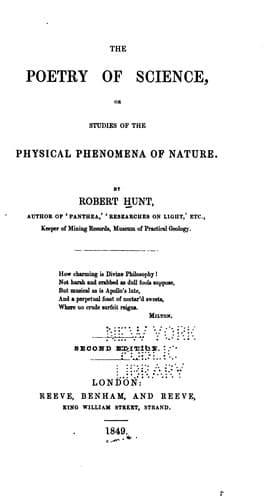
The Poetry of Science; or, Studies of the Physical Phenomena of NatureHunt, Robert
Philosophy
The Poetry of Science; or, Studies of the Physical Phenomena of Nature
Hunt, Robert
Physics; Science
We have, then, this certain truth,--all things visible around us are
but aggregations of atoms. From particles of dust, which under the
microscope could scarcely be distinguished one from the other, are all
the varied forms of nature created. This grain of dust, this particle
of sand, has strange properties and powers. Science has discovered
some truths, but still more are hidden within this irregular molecule
of matter which we now survey, than have yet been shadowed in the
dreams of our philosophy. How strangely it obeys the impulses of
heat--mysterious are the influences of light upon it--electricity
wonderfully excites it--and still more curious is the manner in which
it obeys the magic of chemical force. These are phenomena which we have
seen; we know them, and we can reproduce them at our pleasure. We have
advanced a little way into the secrets of nature, and from the spot we
have gained, we look forward with a vision somewhat brightened by our
task; but we discover so much to be yet unknown, that we learn another
truth,--our vast ignorance of many things relating to this grain of
dust.
It gathers around it other particles; they cling together, and each
acting upon every other one, and all of them arranging themselves
around the little centre according to some law, a beautiful crystal
results, the geometric perfection of its form being a source of
admiration.
It exerts some other powers, and atom cohering to atom, obeying the
influences of many external radiant forces, undergoes inexplicable
changes, and the same dust which we find forming the diamond,
aggregates into the lordly tree,--blends to produce the graceful,
scented, and richly painted flower,--and combines to yield the luxury
of fruit.
It quickens with yet undiscovered energies; it moves with life: dust
is stirred by the mysterious excitement of vital force; and blood and
bone, nerve and muscle, are the results. Forces, which we cannot by
the utmost refinements of our philosophy detect, direct the whole,
and from the same dust which formed the rock and grew in the tree, is
produced a living and a breathing thing, capable of receiving a Divine
illumination, of bearing in its new state the gladness and the glory of
a Soul.
These considerations lead us to reflect on the amount of our knowledge.
We are led to ask ourselves, what do we know? We know that the world
with all its variety is composed of certain material atoms, which,
although presented to us in a great variety of forms, do not in all
probability differ very essentially from each other.
Public-domain text, read in full here on John Shaqi.
Reviews
Reviews
No reviews yet
Be the first to share your thoughts on this work.
Join the Discussion
Join the discussion
Sign in to leave a comment or review.
Sign InorCreate an account