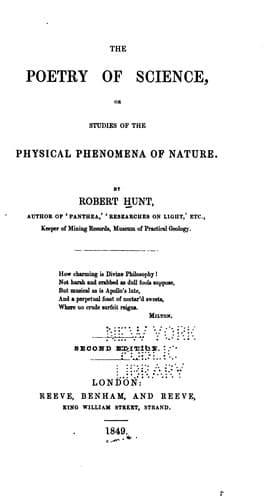
The Poetry of Science; or, Studies of the Physical Phenomena of NatureHunt, Robert
Philosophy
The Poetry of Science; or, Studies of the Physical Phenomena of Nature
Hunt, Robert
Physics; Science
We know that those atoms obey certain conditions which appear to be
dependent upon the influences of motion, gravitation, heat, light,
electricity, and chemical force. These powers are only known to us
by their effects; we only detect their action by their operations
upon matter; and although we regard the several phenomena which we
have discovered, as the manifestations of different principles, it is
possible they may be but modifications of some one universal power, of
which these are but a few of its modes of action.
In examining, therefore, the truths which science has revealed to us,
it is advantageous, for the purpose of fixing the mind to the subject,
that we assume certain conditions as true. These may be stated in a few
sentences, and then, without wasting a thought upon those metaphysical
subtleties which have from time to time perplexed science, and served
to impede the progress of truth, we shall proceed to examine our
knowledge of the phenomena which constantly occur around us.
Every form, whether inorganic or organic, which we can discover within
the limits of human search, is composed of atoms, which are capable of
assuming, under the influence of certain physical forces, conditions
essential to the physical state of that body of which they constitute
a part.[1] The known forces, active in producing these conditions,
are modes of motion; gravitation and aggregation, heat, light; and
associated with these, actinism or chemical radiation; electricity,
under all its conditions, whether static or dynamic; and chemical
affinity, regarded as the result of a separate elementary principle.
These forces must be considered as powers capable of acting in perfect
independence of each other. They are possibly modifications of one
principle; but this view being an hypothesis, which, as yet, is only
supported by loose analogies, cannot, without danger, be received in
any explanation which attempts to deal only with the truths of science.
We cannot examine the varied phenomena of nature, without feeling that
there must be other and most active principles of a higher order than
any detected by science, to which belong the important operations of
vitality, whether manifested in the plant or the animal. In treating
of these, although speculation cannot be entirely avoided, it will be
employed only so far as it gives any assistance in linking phenomena
together.
We have to deal with the active agencies which give form and feature to
nature--which regulate the harmony and beauty and vigour of life--and
upon which depend those grand changes in the conditions of matter,
which must convince us that death is but the commencement of a new
state of being.
FOOTNOTES:
[1] Sir Isaac Newton supposed matter to consist of hard, impenetrable,
perfectly inelastic atoms.
Public-domain text, read in full here on John Shaqi.
Reviews
Reviews
No reviews yet
Be the first to share your thoughts on this work.
Join the Discussion
Join the discussion
Sign in to leave a comment or review.
Sign InorCreate an account