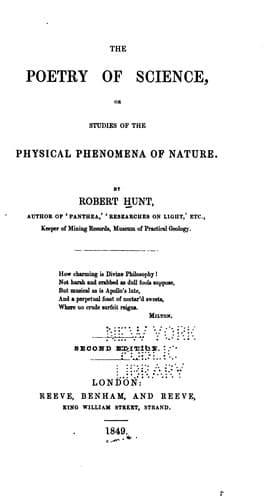
The Poetry of Science; or, Studies of the Physical Phenomena of NatureHunt, Robert
Philosophy
The Poetry of Science; or, Studies of the Physical Phenomena of Nature
Hunt, Robert
Physics; Science
We find, when we receive solar spectra upon iodized plates, or on
several kinds of photographic paper, that a line, over which no action
takes place, is preserved at the top and bottom of the impressed image,
and in many cases along the sides also. The only way in which this can
be accounted for, as the spectrum represents the sun in a distorted
form, is by supposing that rays come from the edges of the sun of a
different character from those which proceed from the centre of that
orb.[129]
Light from the centre of the solar disc is under different conditions
from that which comes from the edge of the sun: this is due to the
varying angle, which is presented to us by a circular body: calorific
action seems to be more strongly manifested when the envelope of
light, extending like an atmosphere to the sun, is thrown into great
agitation, and waves, and great hollows--solar spots--are produced.
There is some indication of the existence of a third condition on the
sun’s surface, to which probably belongs the mighty chemical power
which we call actinism. Electricity may be, as some have speculated,
the exciting agent; a constant and violent Aurora Borealis may exist on
the sun, and under the excitation of this force the others named may be
quickened into full activity.
That actinism is one of the great powers of creation we have abundant
proof. Nearly all the phenomena of chemical change which have been
referred to light, are now proved to be dependent upon actinic power;
and beyond the influence which has been ascertained to be exerted by
it upon all inorganic bodies, we shall have occasion to show still
further the dependence of the vegetable and animal worlds upon its
agency. The influence of the solar beams on vegetation is proved by
common experience; the closer examination of its action on vegetable
life is reserved for the chapter devoted to its phenomena. Of its
influence on animals nothing is very correctly known; but some early
experiments prove that they, like other organised bodies, are subject
to all the radiant forces, as indeed, independent of experiment, every
observation must teach. Certain it is, that organisation can take place
only where the sun’s rays can penetrate: where there is unchanging
darkness, there we find all the silence of death. Prometheus stole
fire from heaven, and gave the sacred gift to man, as the most useful
to him of all things in his necessities: by the aid of it he could
temper the severities of climate, render his food more digestible and
agreeable, and illuminate the hours of darkness. So says the beautiful
fiction of the Grecian mind,--which appears as the poetic dream or
prophetic glance of a gifted race, who felt the mysterious truth
they were yet unable to describe. Pheaton and Apollo are only other
foreshadowings of the creative energies which dwell in the glorious
centre of our universe. The poetry of the Hellenic people ascended
Public-domain text, read in full here on John Shaqi.
Reviews
Reviews
No reviews yet
Be the first to share your thoughts on this work.
Elsewhere in the archive
Join the Discussion
Join the discussion
Sign in to leave a comment or review.
Sign InorCreate an account