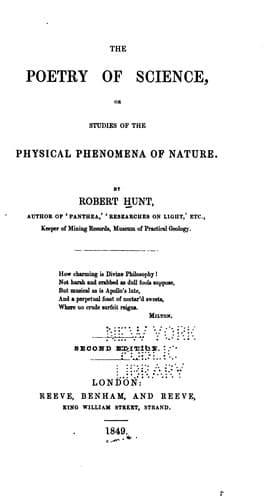
The Poetry of Science; or, Studies of the Physical Phenomena of NatureHunt, Robert
Philosophy
The Poetry of Science; or, Studies of the Physical Phenomena of Nature
Hunt, Robert
Physics; Science
above the littlenesses of merely human action, and sought to interpret
the great truths of creation. Reflective, they could not but see that
some mysterious powers were at work around them; imaginative, they gave
to fine idealisations the government of those inexplicable phenomena.
Modern science has shown what vastly important offices the solar rays
execute, and that the principles discovered in a sunbeam are indeed the
exciters of organic life, and the disposers of inorganic form.
It must not be forgotten that we have already alluded to a speculation
which supposes this actinic influence to be diffused through all
nature, to be indeed the element to which chemical force in all its
forms is to be referred, and that it is merely excited by the solar
rays. This hypothesis receives some support from the very peculiar
manner in which chemical action once set up is carried on, independent
of all extraneous excitement, after the first disturbance has been
produced. If any of the salts of gold are exposed in connection with
organic matter, as on paper, to sunshine for a moment, an action is
begun, which goes on unceasingly in the dark, until the gold is reduced
to its most simple state.[130] The same thing occurs with chromate of
silver, some of the salts of mercury, argentine preparations combined
with protosulphate of iron or gallic acid, and some other chemical
combinations. These progressive influences point to some law not yet
discovered, which seems to link this radiant actinism with the chemical
agent existing in all matter.
This problem also connects itself with another class of facts which,
although due, in all probability, to a great extent, to calorific
radiations, and hence known under the general term of Thermography,
appear to involve both chemical and electrical excitation. From the
investigations of Moser and of others, we learn the very extraordinary
fact, that even inanimate masses act and react upon each other by
the influence of some dark radiations, and seem to exchange some of
the peculiarities which they possess. This appears generally in the
curious experiments which have been referred to, as confined merely
to form or structure. Thus an engraved plate will give to a polished
surface of metal or glass placed near it, after a very little time,
a neat distinct image of itself; that is, produce such a structural
disturbance as will occasion the plate to receive vapour differently
over those spaces opposite to the parts in cameo or in intaglio, from
what it does over the opposite. If a piece of wood is used instead of a
metal, there will, by similar treatment, be produced a true picture of
the wood, even to the representation of its fibres.[131]
Public-domain text, read in full here on John Shaqi.
Reviews
Reviews
No reviews yet
Be the first to share your thoughts on this work.
Elsewhere in the archive
Join the Discussion
Join the discussion
Sign in to leave a comment or review.
Sign InorCreate an account