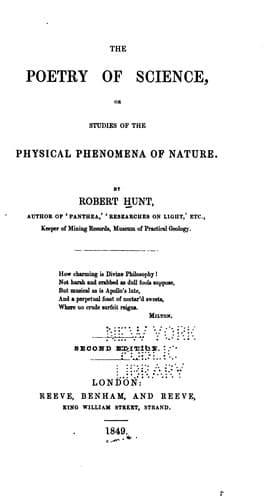
The Poetry of Science; or, Studies of the Physical Phenomena of NatureHunt, Robert
Philosophy
The Poetry of Science; or, Studies of the Physical Phenomena of Nature
Hunt, Robert
Physics; Science
It is also probable that chemical decomposition is produced by the
mere juxtaposition of different bodies. Iodide of gold or silver,
perfectly pure, has been placed upon a plate of glass, and a plate of
copper covered with mercury suspended over it: a gradual decomposition
of those salts is said to have been observed, iodide of mercury to
be formed, and the gold or silver salts reduced to a finely divided
metallic state.[132]
A body whose powers of radiating heat are low, being brought near
another whose radiating powers are more extensive, will, in the course
of a short time, undergo such an amount of molecular disturbance as
will effect a complete change in the arrangement of its surface, and
an impression of the body having the highest radiating powers will be
made upon the other. This impression is dormant, but may be developed
under the influence of vapour, or of oxidation.[133] A body, such
as charcoal, of low conducting power, being placed near another,
such as copper, which is a good conductor, will, in a very short
time, produce, in like manner, an impression of itself upon the metal
plate. Thus any two bodies, whose conducting or radiating powers are
dissimilar, being brought near each other, will occasion a molecular
disturbance, or impress the one with the image of the other. However
small the difference may be, an effect is perceived, and that of the
most extraordinary kind, giving rise to the production of actual images
upon each surface exposed. It is thus that a print on paper may be
copied on metal, by merely suspending it near a well-polished plate of
silver or copper for a few days. The white and black lines radiate very
differently; consequently an effect is produced on the bright metal in
the parts corresponding to the black lines, dissimilar to that which
takes place opposite to the white portions of the paper; and, on the
application of vapour, a true image of the one is found impressed upon
the other.[134]
Bodies which are in different electrical states act upon each other in
an analogous manner. Thus arsenic, which is highly electro-negative,
will, when placed near a piece of electro-positive copper, readily
impart to its surface an impression of itself, and so in like manner
will other bodies if in unlike conditions. Every substance physically
different (it signifies not whether as it regards colour, chemical
composition, mechanical structure, calorific condition, or electrical
state,) has a power of radiation by which a sensible change can be
produced in a body differently constituted.
Public-domain text, read in full here on John Shaqi.
Reviews
Reviews
No reviews yet
Be the first to share your thoughts on this work.
Elsewhere in the archive
Join the Discussion
Join the discussion
Sign in to leave a comment or review.
Sign InorCreate an account