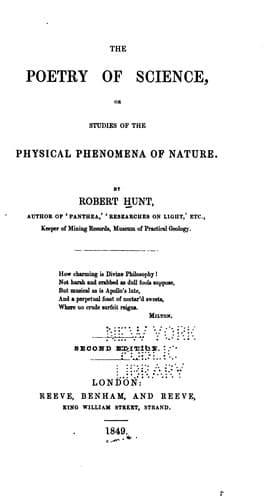
The Poetry of Science; or, Studies of the Physical Phenomena of NatureHunt, Robert
Philosophy
The Poetry of Science; or, Studies of the Physical Phenomena of Nature
Hunt, Robert
Physics; Science
intimate relations are secured by the aids of science, the barrier of
prejudice may be razed to the ground, and not one stone left to stand
upon another? Our contentions, our sanguinary wars, consecrated to
history by the baptism of blood, have in every, or in nearly every,
instance sprung from the force of prejudice, or the mistakes of
politicians, whose minds were narrowed to the limits of a convention
formed for perpetuating the reign of ignorance.
And can anything be more in accordance with the spirit of all that we
revere as holy, than the idea that the elements employed by the All
Infinite in the works of physical creation shall be made, even in the
hands of man, the ministering angels to the great moral redemption of
the world? Associate the distant nations of the earth, and they will
find some common ground on which they may unite. Mortality compels a
dependence; and there are charities which spring up alike in the breast
of the savage and the civilized man, which will not be controlled by
the cold usages of pride, but which, like all truths, though in a still
small voice, speak more forcibly to the heart than errors can, and
serve as links in the great chain which must bind mankind in a common
brotherhood. “None are all evil,” and the best have much to learn of
the amenities of life from him who yet lives in a “state of nature,” or
rather from him whose sensualities have prevailed over his intellectual
powers, but who still preserves many of the noblest instincts, to give
them no higher term, which other races, proud of their intelligence,
have thrown aside. Time and space have hitherto prevented the
accomplishment of this; electricity and mechanics promise to subdue
both; and we have every reason to hope those powers are destined to
accelerate the union of the vast human family.
Electrical power has also been employed for the purpose of measuring
time, and by its means a great number of clocks can be kept in a state
of uniform correctness, which no other arrangement can effect. A
battery being united with the chief clock, which is itself connected
by wires with any number of clocks arranged at a distance from each
other, has the current continually and regularly interrupted by the
beating of the pendulum, which interruption is experienced by all the
clocks included in the electric circuit; and, in accordance with this
breaking and making contact, the indicators or hands move over the dial
with a constantly uniform rate. Instead of a battery the earth itself
has supplied the stream of electric fluid, with which the rate of its
revolutions has been registered with the utmost fidelity.[169]
Electricity, which is now employed to register the march of time,
rushes far in advance of the sage who walks with measured tread,
watching the falling sands in the hour-glass.
Public-domain text, read in full here on John Shaqi.
Reviews
Reviews
No reviews yet
Be the first to share your thoughts on this work.
Elsewhere in the archive
Join the Discussion
Join the discussion
Sign in to leave a comment or review.
Sign InorCreate an account