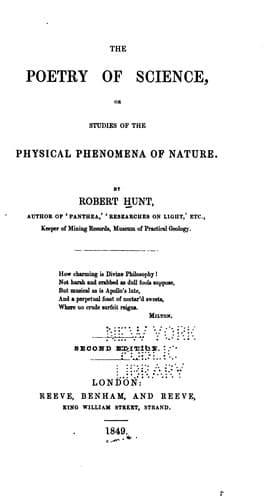
The Poetry of Science; or, Studies of the Physical Phenomena of NatureHunt, Robert
Philosophy
The Poetry of Science; or, Studies of the Physical Phenomena of Nature
Hunt, Robert
Physics; Science
That magnetism has a directive power is satisfactorily shown by
the formation of crystals in the neighbourhood of the poles of
powerful magnets. The common iron salt, the protosulphate, ordinarily
crystallizes so that the crystals unite by their faces; but when
crystallizing under magnetic influence, they have a tendency to arrange
themselves with regard to each other so that the acute angle of one
crystal unites with one of the faces of another crystal, near to, but
never actually at, its obtuse angle. In addition to this, if a magnet
of sufficient power is employed, the crystals arrange themselves in
magnetic curves from one pole to the other, a larger crop of crystals
being always formed at the north than at the south pole. Here we have
evidence of an actual turning round of the crystal, in obedience to the
directive force of the magnet; and we have the curious circumstance of
a difference in some way, which is not clearly explained, between the
two opposite poles. If, instead of an iron or a ferro-magnetic salt,
we employ one which belongs to the other, or diamagnetic, class, we
have a curious difference in the result. If into a glass dish, fixed
on the poles of a strong electro-magnet, we pour a quantity of a
solution of nitrate of silver, and place in the fluid, over the poles
of the magnet, two globules of mercury (an arrangement by which that
arborescent crystallization, called the _Arbor Dianæ_, is produced,) we
have the long needle-shaped crystals of silver, arranging themselves in
curves which would cut the ordinary magnetic lines at right angles.[192]
In the first example given we have an exhibition of magnetic force,
while in the last we have a striking display of the diamagnetic power.
The large majority of natural formations appear to group themselves
under the class of diamagnetics. These bodies are thought to possess
poles of mutual repulsion among themselves, and which are equally
repelled by the magnetic points of convergence. Confining our ideas to
single particles in one condition or the other, we shall, to a certain
extent, comprehend the manifold results which must arise from the
exercise of these two modes of force. At present, our knowledge of the
laws of magnetism is too limited to allow of our making any general
deductions relative to the disposition of the molecules of matter; and
the amount of observation which has been given to the great natural
arrangements, is too confined to enable us to infer more than that it
is probable many of the structural conditions of our planet are due to
polarity.
Public-domain text, read in full here on John Shaqi.
Reviews
Reviews
No reviews yet
Be the first to share your thoughts on this work.
Elsewhere in the archive
Join the Discussion
Join the discussion
Sign in to leave a comment or review.
Sign InorCreate an account