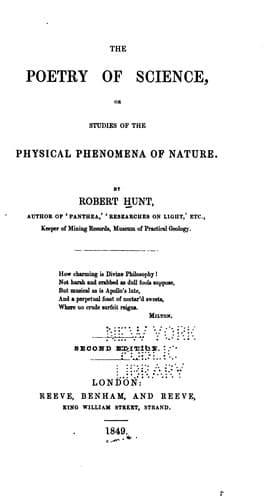
The Poetry of Science; or, Studies of the Physical Phenomena of NatureHunt, Robert
Philosophy
The Poetry of Science; or, Studies of the Physical Phenomena of Nature
Hunt, Robert
Physics; Science
Mountain ranges observe a singular uniformity of direction, and
the cleavage planes of rock are evidently determined by some
all-pervading power. Mineral bodies are not distributed in all
rocks indiscriminately. The primary formations hold one class of
metalliferous ores, and the more recent ones another. This is not
to be regarded as in any way connected with their respective ages,
but with some peculiar condition of the stone itself. The granite
and slate rocks, at their junctions, present the required conditions
for the deposit of copper ore, while we find the limestones have the
characteristic physical state for accumulating lead ore. Again, on
examining any mineral vein, it will be at once apparent that every
particle of ore, and every crystal of quartz or limestone, is disposed
in a direction which indicates the exercise of some powerful directive
agency.[193]
It appears, from all the results hitherto obtained, that the magnetic
and diamagnetic condition of bodies is equally due to some peculiar
property of matter in relation to the other forms of electricity. We
have not yet arrived at the connecting link, but it does not appear to
be far distant.
We have already referred to the statement made by talented
experimentalists, that magnetism has a powerful influence in either
retarding or accelerating chemical combination. Beyond a doubt chemical
action weakens the power of a magnet; but the disturbance which it
occasions in soft iron, on the contrary, appears to tend to its
receiving magnetism more readily, and retaining it more permanently.
Further investigations are, however, required, before we can decide
satisfactorily either of these problems, both of which bear very
strongly upon the subject we have just been considering.
We have seen that heat and electricity act strangely on magnetic force,
and that this statical power reacts upon them: and thus the question
naturally arises, Do light and magnetism in any way act upon each other?
Morichini and Carpi on the continent, and Mrs. Somerville in England,
have stated that small bars of steel can be rendered magnetic by
exposing them to the influence of the violet rays of light. These
results have been denied by others, but again repeated and apparently
confirmed. In all probability, the rays to which the needles were
exposed, being those in which the maximum actinic power is found,
produced an actual chemical change; and then, if the position were
favourable, it is quite evident that magnetism would be imparted.
Indeed we have found this to be the case when the needles, exposed to
solar radiations, were placed in the direction of the dip. The supposed
magnetization of light by Faraday has already been mentioned. If the
influence in one case is determined, it will render the other more
probable.[194]
Public-domain text, read in full here on John Shaqi.
Reviews
Reviews
No reviews yet
Be the first to share your thoughts on this work.
Elsewhere in the archive
Join the Discussion
Join the discussion
Sign in to leave a comment or review.
Sign InorCreate an account