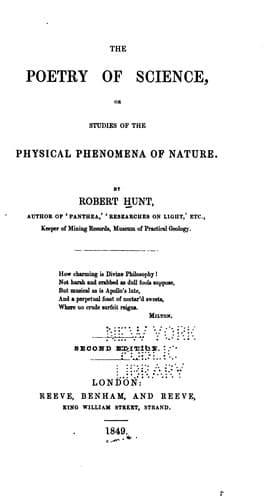
The Poetry of Science; or, Studies of the Physical Phenomena of NatureHunt, Robert
Philosophy
The Poetry of Science; or, Studies of the Physical Phenomena of Nature
Hunt, Robert
Physics; Science
“If Mr. Hobbes should reply that the motion is impressed upon any of
the parts of matter by God, he will say that which I most readily grant
to be true, but will not serve his turn, if he would speak congruously
with his own hypothesis. For I demand whether this Supreme Being
that the assertion has recourse to, be a corporeal or an incorporeal
substance? If it be the latter, and yet the efficient cause of motion
in bodies, then it will not be universally true that whatever body is
moved is so by a body contiguous and moved. For, in our supposition,
the bodies that God moves, either immediately or by the intervention
of any other immaterial being, are not moved by a body contiguous,
but by an incorporeal spirit.”--_Some Considerations about the
Reconcileableness of Reason and Religion_: Boyle, vol. iii. p. 520.
[5] Boyle has some ingenious speculations on this point:--
“That there is local motion in many parts of matter is manifest to
sense, but how matter came by this motion was of old, and is still,
hotly disputed of: for the ancient Corpuscularian philosophers (whose
doctrine in most other points, though not in all, we are the most
inclinable to), not acknowledging an author of the universe, were
thereby reduced to make motion congenite to matter, and consequently
coeval with it. But since local motion, or an endeavour at it, is not
included in the nature of matter, which is as much matter when it rests
as when it moves; and since we see that the same portion of matter may
from motion be reduced to rest, and after it hath continued at rest, so
long as other bodies do not put it out of that state, may by external
agents be set a moving again; I, who am not wont to think a man the
worse naturalist for not being an atheist, shall not scruple to say
with an eminent philosopher of old, whom I find to have proposed among
the Greeks that opinion (for the main) that the excellent Des Cartes
has revived amongst us, that the origin of motion in matter is from
God; and not only so, but that thinking it very unfit to be believed,
that matter barely put into motion, and then left to itself, should
casually constitute this beautiful and orderly world; I think also
further, that the wise Author of things did, by establishing the laws
of motion among bodies, and by guiding the first motions of the small
parts of matter, bring them to convene after the manner requisite
to compose the world; and especially did contrive those curious and
elaborate engines, the bodies of living creatures, endowing most of
them with the power of propagating their species.”--_Considerations and
Experiments touching the Origin of Forms and Qualities_: Boyle’s Works,
vol. ii. p. 460. Edinburgh. 1744.
[6] Cudworth’s _Intellectual System_.
Public-domain text, read in full here on John Shaqi.
Reviews
Reviews
No reviews yet
Be the first to share your thoughts on this work.
Join the Discussion
Join the discussion
Sign in to leave a comment or review.
Sign InorCreate an account