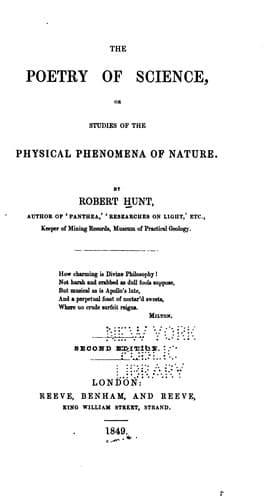
The Poetry of Science; or, Studies of the Physical Phenomena of NatureHunt, Robert
Philosophy
The Poetry of Science; or, Studies of the Physical Phenomena of Nature
Hunt, Robert
Physics; Science
[2] “Motion, therefore, is a change of rectilinear distance between
two points. Allowing the accuracy of this definition, it appears that
two points are necessary to constitute motion; that in all cases, when
we are inquiring whether or no any body or point is in motion, we must
recur to some other point which we can compare with it; and that if a
single atom existed alone in the universe, it could neither be said to
be in motion nor at rest.
“The space which we call quiescent is in general the earth’s surface;
yet we well know, from astronomical considerations, that every point of
the earth’s surface is perpetually in motion, and that in very various
directions: nor are any material objects accessible to our senses which
we can consider as absolutely motionless, or even as motionless with
regard to each other; since the continual variation of temperature to
which all bodies are liable, and the minute agitations arising from the
motion of other bodies with which they are connected, will always tend
to produce some imperceptible changes in their distances.”--_Lectures
on Natural Philosophy, &c._, by Thomas Young, M.D. Edited by the Rev.
P. Kelland. 1845.
[3] “The position which I seek to establish in this essay is, that
the various imponderable agencies, or the affections of matter which
constitute the main objects of experimental physics, viz., heat,
light, electricity, magnetism, chemical affinity, and motion, are all
correlative, or have a reciprocal dependence;--that neither, taken
abstractedly, can be said to be the essential or proximate cause of the
others; but that either may, as a force, produce, or be convertible
into, the other:--thus heat may mediately or immediately produce
electricity, electricity may produce heat, and so of the rest....
Although strongly inclined to believe that the five other affections of
matter, which I have above named, are, and will ultimately be, resolved
into modes of motion, it would be going too far at present to assume
their identity with it: I, therefore, use the term force, in reference
to them, as meaning that active force inseparable from matter, which
induces its various changes.”--_On the Correlation of Physical Forces_,
by W. R. GROVE, Esq., M.A., F.R.S.
[4] When discussing the hypothesis of Hobbes--_that no body can
possibly be moved but by a body contiguous and moved_--Boyle asks:--
“I demand how there comes to be local motion in the world? For either
all the portions of matter that compose the universe have motion
belonging to their natures, which the Epicureans affirmed for their
atoms, or some parts of matter have this motive power, and some have
not, or else none of them have it; but all of them are naturally
devoid of motion. If it be granted that motion does naturally belong
to all parts of matter, the dispute is at an end, the concession quite
overthrowing the hypothesis.
Public-domain text, read in full here on John Shaqi.
Reviews
Reviews
No reviews yet
Be the first to share your thoughts on this work.
Join the Discussion
Join the discussion
Sign in to leave a comment or review.
Sign InorCreate an account