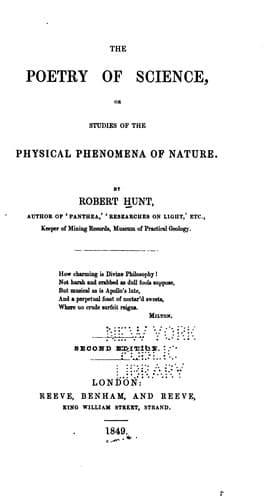
The Poetry of Science; or, Studies of the Physical Phenomena of NatureHunt, Robert
Philosophy
The Poetry of Science; or, Studies of the Physical Phenomena of Nature
Hunt, Robert
Physics; Science
Having reason to conclude that atom combines with atom, according to
a system most harmoniously arranged, there can be no difficulty in
conceiving that molecule unites with molecule, in a manner regulated
by some equally well-marked law. It was, indeed, a discovery by
Wenzel, of Fribourg, that, in salts which decompose each other, the
acid which saturates one base will also saturate the other base;
and the subsequent observations of Richter, of Berlin, who attached
proportional numbers to the acids and bases, and who remarked that the
neutrality of metallic salts does not change during the precipitation
of metals by each other, which led the way to the atomic theory of Dr.
Dalton, to whom entirely belongs the observation, that the equivalent
of a compound body is the sum of the equivalents of its constituents,
and the discovery of combination in multiple proportions.
The elements of a molecule can take a new arrangement amongst
themselves, without any alteration in the number of the atoms or of
their weight, and thus give rise to a body of a different form and
colour, although possessing the same chemical constitution. This is the
case with many of the organic compounds of carbon and hydrogen.
The elements of a compound may be disassociated, and thus the
dissimilar substances of which it is composed set free. A piece
of chalk exposed to heat is, by the disturbance of its molecular
arrangement, changed in its nature; a gaseous body, carbonic acid,
is liberated, and quick-lime (oxide of calcium) is left behind. If
this carbonic acid is passed through red-hot metal tubes, or brought
in contact with heated potassium, it is resolved into oxygen and
charcoal--the oxygen combining with the metal employed. The oxide of
calcium (lime), if subjected to the action of a powerful galvanic
current, is converted into oxygen and a metal, calcium. Thus we learn
that chalk is a body consisting of two compound molecules,--carbonic
acid, which is formed by the combination of an atom of carbon with two
atoms of oxygen,--and lime, which results from the union of an atom of
calcium with one of oxygen.
The condition requisite to the production of chemical action between
bodies is that they should be dissimilar. Two elementary atoms
are placed within the spheres of each other’s influences, and a
compound molecule results. Oxygen and hydrogen form water; oxygen
and carbon give rise to carbonic acid; nitrogen and hydrogen unite
to form ammonia; and chlorine and hydrogen to produce hydrochloric
acid. In all these cases an external force is required to bring the
atoms within the range of mutual affinity: flame,--the electrical
spark,--actinism,--or the interposition of a third body, is necessary
in each case. There are other examples in which no such influence is
required. Potassium and oxygen instantly unite: chlorine, iodine, and
bromine immediately, and with much violence, combine with the metals to
form chlorides, iodides, or bromides.
Public-domain text, read in full here on John Shaqi.
Reviews
Reviews
No reviews yet
Be the first to share your thoughts on this work.
Elsewhere in the archive
Join the Discussion
Join the discussion
Sign in to leave a comment or review.
Sign InorCreate an account