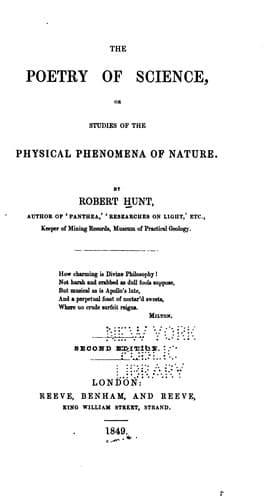
The Poetry of Science; or, Studies of the Physical Phenomena of NatureHunt, Robert
Philosophy
The Poetry of Science; or, Studies of the Physical Phenomena of Nature
Hunt, Robert
Physics; Science
With compound molecules the action is in many cases equally active,
and combination is readily effected, as in the cases of the acids and
the oxides of some metals, which are all instances of the most common
chemical attraction.
An elementary or simple molecule and molecules of a compound and
different constitution are brought together, and a new compound
results from an interchange of their atoms, whilst an element is
liberated. These are essentially illustrations of analytical chemistry.
Sulphuretted hydrogen is mixed with chlorine; the chlorine combines
with the hydrogen, and sulphur is set free. Potassium is put into
water, and it combines with the oxygen of the water, whilst the
hydrogen is liberated.
Two compound molecules being brought together may decompose each other,
and form two new compounds by an interchange of their elements.
One element may be substituted for another under certain circumstances.
Gold may be replaced by mercury; copper will take the place of silver;
and iron will occasion the separation of copper from its solutions,
the iron itself being dissolved to supply its place; chlorine will
substitute hydrogen in the carburetted hydrogen gases; and many other
examples might be adduced.
Chemical phenomena very frequently become of a complex character;
and one, two, or three of these cases may be occurring at the same
time in the decomposition of one compound by another. Such are the
general features of chemical science. Many peculiarities and remarkable
phenomena connected with chemical investigations will be named, as
the examination of the elementary composition of matter is proceeded
with; but, although the philosophy of chemical action is of the highest
interest, it must not be allowed to detain us with its details, which
are, indeed, more in accordance with a treatise on the science than
one which professes to do no more than sketch out those prevailing
and striking features which, whilst they elucidate the great truths
of nature, are capable of being employed as suggestive examples of
the tendency of scientific investigation to enlarge the boundaries of
thought, and give a greater elevation to the mind, leading us from
the merely mechanical process of analysis up to the great synthetical
operations, by which all that is found upon the earth for its ornament,
or our necessities, is created.
Public-domain text, read in full here on John Shaqi.
Reviews
Reviews
No reviews yet
Be the first to share your thoughts on this work.
Elsewhere in the archive
Join the Discussion
Join the discussion
Sign in to leave a comment or review.
Sign InorCreate an account