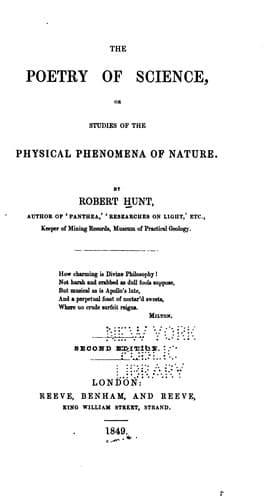
The Poetry of Science; or, Studies of the Physical Phenomena of Nature — John Shaqi
The Poetry of Science; or, Studies of the Physical Phenomena of NatureHunt, Robert
Philosophy
The Poetry of Science; or, Studies of the Physical Phenomena of Nature
Hunt, Robert
Physics; Science
“The apparatus exhibited before the Association consisted of a brass
paddle-wheel, working horizontally in a can of water. Motion could
be communicated to this paddle by means of weights, pulleys, &c. The
paddle moved with great resistance in the can of water, so that the
weights (each of four pounds) descended at the slow rate of about one
foot per second. The height of the pulleys from the ground was twelve
yards, and consequently when the weights had descended through that
distance they had to be wound up again in order to renew the motion of
the paddle. After this operation had been repeated sixteen times, the
increase of the temperature of the water was ascertained by means of a
very sensible and accurate thermometer.
“A series of nine experiments was performed in the above manner, and
nine experiments were made in order to eliminate the cooling or heating
effects of the atmosphere. After reducing the result to the capacity
for heat of a pound of water, it appeared that for each degree of heat
evolved by the friction of water, a mechanical power equal to that
which can raise a weight of 890 lbs. to the height of one foot, had
been expended.
“Any of your readers who are so fortunate as to reside amid the
romantic scenery of Wales or Scotland could, I doubt not, confirm my
experiments by trying the temperature of the water at the top and at
the bottom of a cascade. If my views be correct, a fall of 817 feet
will of course generate one degree of heat, and the temperature of the
river Niagara will be raised about one fifth of a degree by its fall of
160 feet.”--_Relation between Heat and Mechanical Power_: Philosoph.
Mag. vol. xxvii. 1845.
CHAPTER III.
GRAVITATION.
The Forms of Matter--Shape of the Earth--Probability of the Mass
forming this Planet having existed in a Nebulous State--Zodiacal
Lights--Comets--Volatilization of Solid Matter by Artificial
means--The principle of Gravitation--Its Influence through
Space and within the smallest Limits--Gravitating powers of the
Planets--Density of the Earth--Certainty of Newton’s Law of the
Inverse Square--Discovery of Neptune--State of a Body relieved from
Gravitation--Experiment explaining Saturn’s Ring, &c.--General
inference.
Public-domain text, read in full here on John Shaqi.
Reviews
Reviews
No reviews yet
Be the first to share your thoughts on this work.
Join the Discussion
Join the discussion
Sign in to leave a comment or review.
Sign InorCreate an account