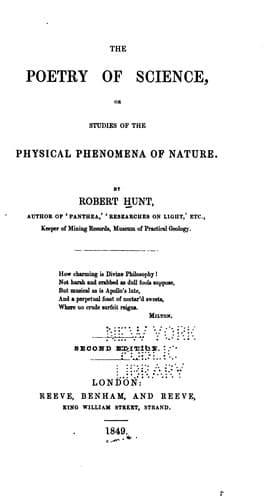
The Poetry of Science; or, Studies of the Physical Phenomena of NatureHunt, Robert
Philosophy
The Poetry of Science; or, Studies of the Physical Phenomena of Nature
Hunt, Robert
Physics; Science
Let us suppose the earth--consisting of three conditions of matter;
the solid, the fluid, and the aëriform--to be set free from that power
by which it is retained in its present form of a spheroid flattened
at the poles, but still subject to the influences of its diurnal and
annual rotations. Agreeably to the law which regulates the conditions
of all bodies moving at high velocities, the consequence of such a
state of things would be, that our planet would instantly spread itself
over an enormous area. The waters and even the solid masses of this
globe would, in all probability, present themselves amidst the other
phenomena of space in a highly attenuated state, revolving in an orbit
around the sun, as a band of nebulous matter, which might sometimes
be rendered sensible to sight by still reflecting solar light, or by
condensation in the form of flights of shooting stars.[13]
This may be illustrated by experiment. If upon a rapidly revolving
disc we place a ball of dust, it will be almost immediately spread
out, and its particles will arrange themselves in a series of regular
curves, varying with the velocity of the motion. In addition to the
disintegration which would arise from the tendency of the atoms to fly
from the centre, the motion, in space, of the planetary mass would
naturally occasion a trailing out, and the only degree of uniformity
which this orb could, under these imaginary conditions, possibly
present, would be derived from the combined effects of motions in
different directions.
Amid the remoter stars, some remarkable cloud-like appearances are
discovered. These nebulæ, presenting to the eye of the observer
only a gleaming light, as from some phosphorescent vapour, were
long regarded as indications of such a condition as that which we
have just been considering. Astronomers saw, in those mysterious
nebulæ, a confirmation of their views, which regarded all the orbs
of the firmament as having once been thin sheets of vapour, which
had gradually, from irregular bodies traversing space, been slowly
condensed about a centre, and brought within the limits of aggregating
agencies, until, after the lapse of ages, they become sphered stars,
moving in harmony amid the bright host of heaven.[14] Geologists seized
on those views with eagerness, as confirming theoretical conclusions
deduced from an examination of the structure of the earth itself, and
explained by them the gradual accretion of atoms into crystalline rocks
from a cooling mass.
Public-domain text, read in full here on John Shaqi.
Reviews
Reviews
No reviews yet
Be the first to share your thoughts on this work.
Join the Discussion
Join the discussion
Sign in to leave a comment or review.
Sign InorCreate an account