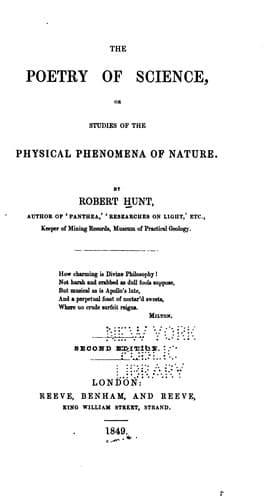
The Poetry of Science; or, Studies of the Physical Phenomena of NatureHunt, Robert
Philosophy
The Poetry of Science; or, Studies of the Physical Phenomena of Nature
Hunt, Robert
Physics; Science
It has been calculated from certain phenomena of refraction, that our
atmosphere must extend to about forty miles from the surface of the
earth. It may, in a state of extreme tenuity, extend still further;
but it is probable that the intense cold produced by rarefaction sets
limits to any extension much beyond this elevation.
The uses of the atmosphere are many. It is the medium for regulating
the dispersion of watery vapours over the earth. If there were no
atmosphere, and that, as now, the equatorial climes were hot and the
poles cold, evaporation would be continually going on at the equator,
and condensation in the colder regions. The sky of the tropical climes
would be perpetually cloudless, whilst in the temperate and arctic
zones we should have constant rain and snow. By having a gaseous
atmosphere, a more uniform state of things is produced; the vapours
arising from the earth become intimately mixed with the air, and are
borne by it over large tracts of country, and only precipitated when
they enter some stratum much colder than that which involves them.
There are opposite tendencies in an atmosphere of air and one of
vapour. The air circulates from the colder to the warmer parts, and
the vapour from the warmer to the colder regions; and as the currents
of the air, from the distribution of land and sea--the land, from its
low conducting power, being more quickly heated than the sea--are
very complicated, and as some force is employed in keeping the vapour
suspended in the air, water is less suddenly deposited on the earth
than it would have been, had not these tendencies of the air and its
hygrometric peculiarities been such as we find them.
The blue colour of the sky, which is so much more agreeable to the eye
than either red or yellow, is due to a tendency of the mixed gas and
vapour to reflect the blue rays rather than red or yellow. The white
light which falls upon the surface of the earth, without absorption or
decomposition in its passage from the sun, is partially absorbed by,
and in part reflected back from, the earth. The reflected rays pass
with tolerable freedom through this transparent medium, but a portion
of the blue rays are interrupted and rendered visible to us. That it
is reflected light, is proved by the fact of its being in a polarized
state.[226] Clouds of vapour reflect to us again, not isolated rays,
but the undecomposed beam, and consequently they appear white as snow
to our vision.
Public-domain text, read in full here on John Shaqi.
Reviews
Reviews
No reviews yet
Be the first to share your thoughts on this work.
Elsewhere in the archive
Join the Discussion
Join the discussion
Sign in to leave a comment or review.
Sign InorCreate an account