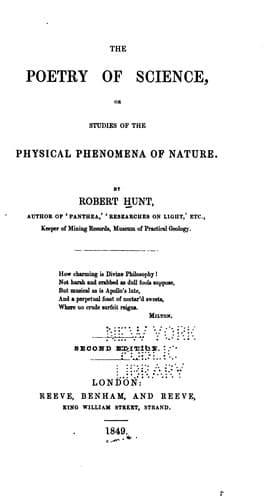
The Poetry of Science; or, Studies of the Physical Phenomena of NatureHunt, Robert
Philosophy
The Poetry of Science; or, Studies of the Physical Phenomena of Nature
Hunt, Robert
Physics; Science
The golden glories of sunset,--when, “like a dying dolphin,” heaven
puts on the most gorgeous hues, which are continually changing,--depend
entirely upon the quantity of watery vapour which is mixed with air,
and its state of condensation. It has been observed, that steam at
night, issuing into the atmosphere under a pressure of twenty or thirty
pounds to the square inch, transmits and reflects orange-red light.
This we may, therefore, conclude to be the property of such a condition
of mixed vapour and air, as prevails when the rising or the setting
sun is shedding over the eastern or the western horizon the glory of
its coloured rays.[227]
Thus science points out to us the important uses of the air. We learn
that life and combustion are entirely dependent on it, and that it
is made the means for securing greater constancy in the climates
of the earth than could otherwise be obtained. The facts already
dwelt upon are sufficient to convince every thinking mind that the
beautiful system of order which is displayed in the composition of
the atmosphere, in which the all-exciting element, oxygen, is subdued
to a tranquil state by another element, nitrogen, (which, we shall
have presently to show, is itself, under certain conditions, one of
the most energetic agents with which we are acquainted,) indicates a
supreme power, omniscient in the adaptation of things to an especial
end. Oxygen and nitrogen are here _mixed_ for the benefit of man;
man _unites_ them by the aid of powers with which he is gifted, and
the consequences are of a fatal kind. The principles which the great
Chemist of Nature renders mild are transformed into sources of evil by
the chemist of art.
Beyond all this, the atmosphere produces effects on light which add
infinitely to the beauty of the world. Were there no atmosphere, we
should only see those objects upon which the sun’s rays directly fell,
or from which they were reflected. A ray falling through a small hole
into a dark room, illuminating one object, which reflects some light
upon another, is an apt illustration of the effect of light upon
the earth, if it existed without its enveloping atmosphere. By the
dispersive powers of this medium, sunlight is converted into daylight;
and instead of unbearable, parallel rays illuminating brilliantly,
and scorching up with heat those parts upon which they directly
fall, leaving all other parts in the darkness of night, we enjoy the
blessings of a diffusion of its rays, and experience the beauties of
soft shades and slowly-deepening shadows. Without an atmosphere, the
sun of the morning would burst upon us with unbearable brilliancy, and
leave us suddenly, at the close of day, at once in utter darkness. With
an atmosphere we have the twilight with all its tempered loveliness,--a
“time for poets made.”
Public-domain text, read in full here on John Shaqi.
Reviews
Reviews
No reviews yet
Be the first to share your thoughts on this work.
Elsewhere in the archive
Join the Discussion
Join the discussion
Sign in to leave a comment or review.
Sign InorCreate an account