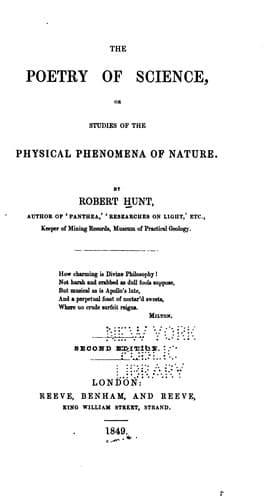
The Poetry of Science; or, Studies of the Physical Phenomena of NatureHunt, Robert
Philosophy
The Poetry of Science; or, Studies of the Physical Phenomena of Nature
Hunt, Robert
Physics; Science
In chemical character, atmospheric air is composed of twenty-one
volumes of oxygen, and seventy-nine volumes of nitrogen: or one hundred
grains of air consist of 23·1 grains of the former, and 76·9 grains
of the latter. Whether the air is taken from the greatest depths or
the most exalted heights to which man has ever reached, an invariable
proportion of the gases is maintained. The air of Chimborazo, of the
arid plains of Egypt, of the pestilential delta of the Niger, or
even of the infected atmosphere of an hospital, all give the same
proportions of these two gases as we find existing on the healthful
hills of Devonshire, or in the air of the city of London. This
constancy in constitution leads to the supposition that the oxygen
and nitrogen are chemically combined; but many eminent philosophers
have contended that they are merely mechanically mixed; and they have
shown that some peculiar properties prevail amongst gaseous bodies,
which very fully explain the equal admixture of two gases the specific
gravities of which are different. This is particularly exemplified in
the case of carbonic acid, of which gas one per cent. can be detected
in all regions of the air to which the investigations of man have
reached. This gas, although so heavy, is, by the law of diffusion,
mixed with great uniformity throughout the mass.[228] Every exhalation
from the earth, of course, passes into the air; but these are generally
either so light that they are carried into the upper regions, and
there perform their parts in the meteorological phenomena, or they
are otherwise very readily absorbed by water or growing plants, and
thus is the atmosphere preserved in a state of purity for the uses of
animals. Again, the quantity of oxygen contained in the air, and its
very peculiar character, ensures the oxidation of all the volatile
organic matters which are constantly passing off,--as the odoriferous
principles of plants, the miasmata of swamps, and the products of
animal putrefaction; these are rapidly converted into water, carbonic
acid, or nitric acid, and quickly enter into new and harmless
combinations. The elements of contagion we are unacquainted with; but
since the attention of inquirers has been of late directed to this
important and delicate subject, some light may possibly be thrown upon
it before long.
Public-domain text, read in full here on John Shaqi.
Reviews
Reviews
No reviews yet
Be the first to share your thoughts on this work.
Elsewhere in the archive
Join the Discussion
Join the discussion
Sign in to leave a comment or review.
Sign InorCreate an account