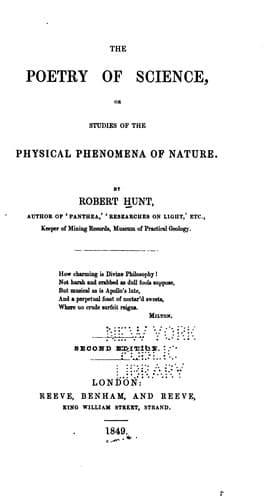
The Poetry of Science; or, Studies of the Physical Phenomena of NatureHunt, Robert
Philosophy
The Poetry of Science; or, Studies of the Physical Phenomena of Nature
Hunt, Robert
Physics; Science
Nothing, shows more strikingly the admirable adaptation of all things
for their intended uses than the atmosphere. In it we find the source
of life and health; and chemistry teaches us, most indisputably,
that it is composed of certain proportions of oxygen and nitrogen
gases; and experience informs us that it is on the oxygen that we
are dependent for all that we enjoy. So beautifully is the atomic or
molecular constitution ordered, that it is impossible to produce any
change in the air without rendering it injurious to the vegetable and
animal economy. It might be thought, from the well-known exhilirating
character of oxygen gas, that, if a larger quantity existed in the
atmosphere than that which we find there, the enjoyments of life would
be of a more exciting kind; but the consequences of any increase would
be exceedingly injurious; and, by quickening all the processes of life
to an unnatural extent, the animal fabric would soon decay: excited
into fever, it would be destroyed by its own fires. Chemistry has made
us acquainted with six other compounds of oxygen and nitrogen, neither
of them fitted for the purposes of vitality, of which the following are
the most remarkable:--
Nitrous oxide, or the, so called, _laughing gas_, which contains two
volumes of nitrogen to one of oxygen, would prove more destructive than
even pure oxygen, from the delirious intoxication which it produces.
Nitric oxide is composed, according to Davy, of two volumes of nitrogen
and two of oxygen. It is of so irritating a nature, that the glottis
contracts spasmodically when any attempt is made to breathe it; and the
moment it escapes into the air it combines with more oxygen, and forms
the deep red fumes of nitrous acid.
Nitrous acid and the peroxide of nitrogen each contains an additional
proportion of oxygen, and they are still more destructive to all
organization.
Nitric acid contains five volumes of oxygen united to two of nitrogen;
and the well-known destructive properties of aqua fortis it is
unnecessary to describe.
The atmosphere, and these chemically active compounds, contain the same
elements, but their mode of combining is different; and what is, in the
one case, poisonous to the highest degree, is, in the other, rendered
salubrious, and essential to all organized beings.
Public-domain text, read in full here on John Shaqi.
Reviews
Reviews
No reviews yet
Be the first to share your thoughts on this work.
Elsewhere in the archive
Join the Discussion
Join the discussion
Sign in to leave a comment or review.
Sign InorCreate an account